I was just trying to do good. As I always do when I’m spaying or neutering a stray cat or a feral one. This time it didn’t go the way that I wanted it to.
It was Spring, 2018. The lady who’d been feeding the cats on the base where I worked in the south of Belgium let me know that there were two pregnant females. The Société pour la Protection des Animaux and the private no-kill rescues were all overrun at the moment with cats and kittens. I knew that we had to get them and either spay them (aborting the babies) or let them have the kittens in security and safety and keep them from being wild, or at least help them to not be too frightened to be adoptable.
This was already about to be a nightmare for me, as I pride myself on what I call my consistent life ethic. I am vegetarian, anti-death penalty, anti-zoo, anti-vivisection, pro-immigration, and anti-abortion. And as to the latter, I’m not what’s come to be known as an anti-birther; I want to take care of babies that are born, somehow, and well. So knowing that on the table was the distinct possibility of aborting kittens was already tearing at me.
On Thursday evening I arrived at the site before their caregiver. A couple of days before, she had told me where the more fearful one would appear, and I set the humane trap there. I withdrew from the area and sat in my car about 100 meters away from the trap; this was a cat who didn’t come very close to her caregiver. I could just see the trap, as it was dusk and pretty far.
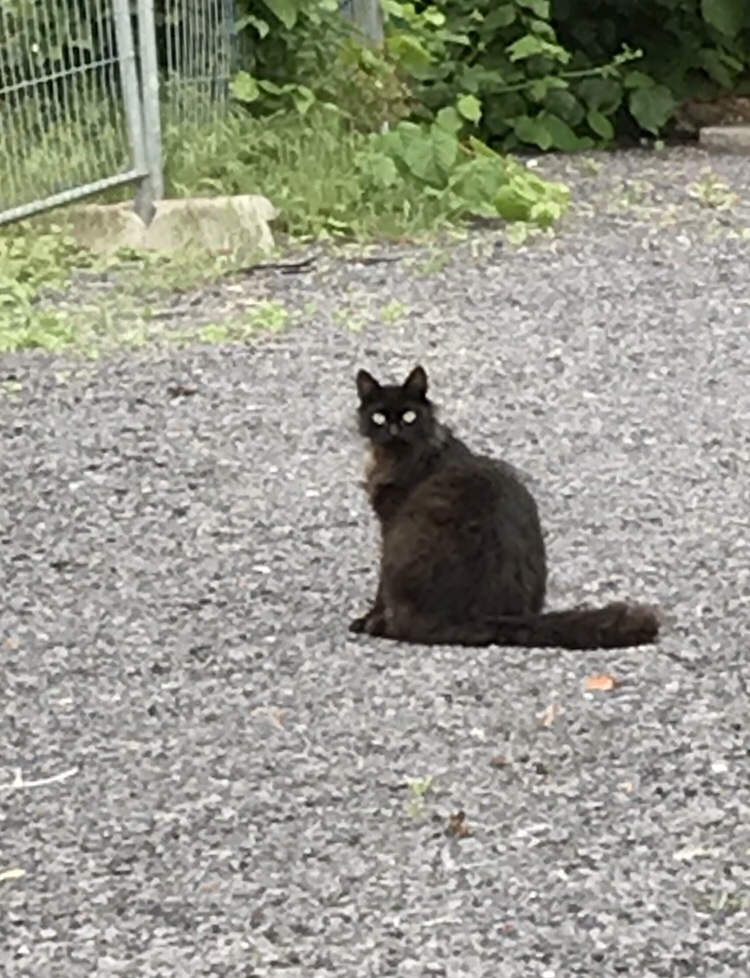
Soon I saw a long-haired black cat approaching the trap. Baited with fresh sardines, I knew that if she was hungry, she would go in. Sure enough, I was shortly rewarded with the distinctive clap of the metal door closing. I grabbed a large towel from my car, ran to the trap, and covered it with a towel because I know that the cat will be less panicky if she can’t see out of the trap. I took a brief peek at her, but she was balled up in the corner as fearful cats tend to do, so I really couldn’t see anything except that it was indeed a long-haired, black cat. I called her caregiver, who was on her way to the site to pick up the other one, a far less fearful short-haired black female. I headed home with the little black cat in the trap.
Shortly after my arrival, the caregiver arrived with the other less wild one in a carrier. We discussed next steps. She was against spaying them immediately; she wanted the cats to be able to have the kittens. Her husband was of the other, more practical, mind. As she is the caregiver, I did not want to do something against her wishes, and of course I was grappling with the reality of killing kittens in their mothers’ wombs anyway. We decided to give it a couple of days to think about what would be best. I put the cats in my “cat room” where they would be safe and where I could look after them well.
Over the course of the next few days, we talked regularly, the caregiver and I. On Sunday, she let me know that she thought it would be best to have the cats spayed immediately thereby ending the lives of the kittens. She had done some homework and found that this is the common solution when the shelters are full. I had expected that this could happen, so I had called on Friday and set an appointment for both of the cats for Monday morning with my vet.
On Monday evening I arrived at the office of my Belgian vet to pick up the cats and bring them home for their recovery. The veterinarian’s mother, who is her assistant, came out and said something in French that I asked her to repeat. “The longer haired one was not pregnant; she already has kittens somewhere. She had a litter of kittens five or more weeks ago.” The look on my face must have communicated volumes. “Mais oui,” she responded.
My heart dropped.
A few minutes later the veterinarian emerged from the treatment area. “She had probably five or six kittens she said, at least five weeks ago. Maybe longer, but at a minimum five weeks,” she told me. “I can tell by the way her uterus has gone back into shape that it has to be at least five weeks.” By now I’m practically sobbing. “They can’t survive this long, can they?” I demanded. “It’s been since Thursday that she’s been away from them!” The veterinarian grimaced. “If someone is feeding them, perhaps. But it has been quite cold.”
“By now they’re likely dead,” I admitted. The veterinarian’s facial expression told me she thought I was right. I rushed home, called the caregiver on the way (who was as devastated as I was), dropped the two cats off to my cat room for at least a day or two of recovery, and rushed back to the base where I spent the next hour and a half walking in the fine misty rain, near where I had trapped the momma cat. It was nearly dark, and the area is filled with possible hiding places.
Shining my flashlight under the many small buildings, in the brush, amongst the new Spring growth in the light wooded areas, I searched, looking in vain for the glow of eyes or furtive movements.
In the following days, I repeated the walk, drove around the area, asked for info on the local Facebook page, and banged on a door after hours so I could talk with the people inside the building who had placed a dish of cat food outside. No one has seen any kittens. Cats, yes. Kittens, no.
More than likely, with the cold, they got hungry, and when mama didn’t come back, they snuggled up in a pile and died of hypothermia. I didn’t know this for certain, but it was the most likely outcome.
At the moment I was having a hard time forgiving myself. The poor mama cat must have been wondering what happened to her babies. Yes, I know animals mourn. I am sure she was mourning…her babies and her lost freedom.
The caregiver adopted the less wild one, Lily. I called the wilder one Mama Rose. She remained in the cat room for the next ten days so I could try to socialize her in the hope that she might be adoptable. Alas, it was not to be. She was too traumatized and frightened, so I released her where I’d caught her, where she’d be fed and have familiar places to hunker down in the weather. She regained her freedom, but she will never regain those babies.
And then, a few days later…
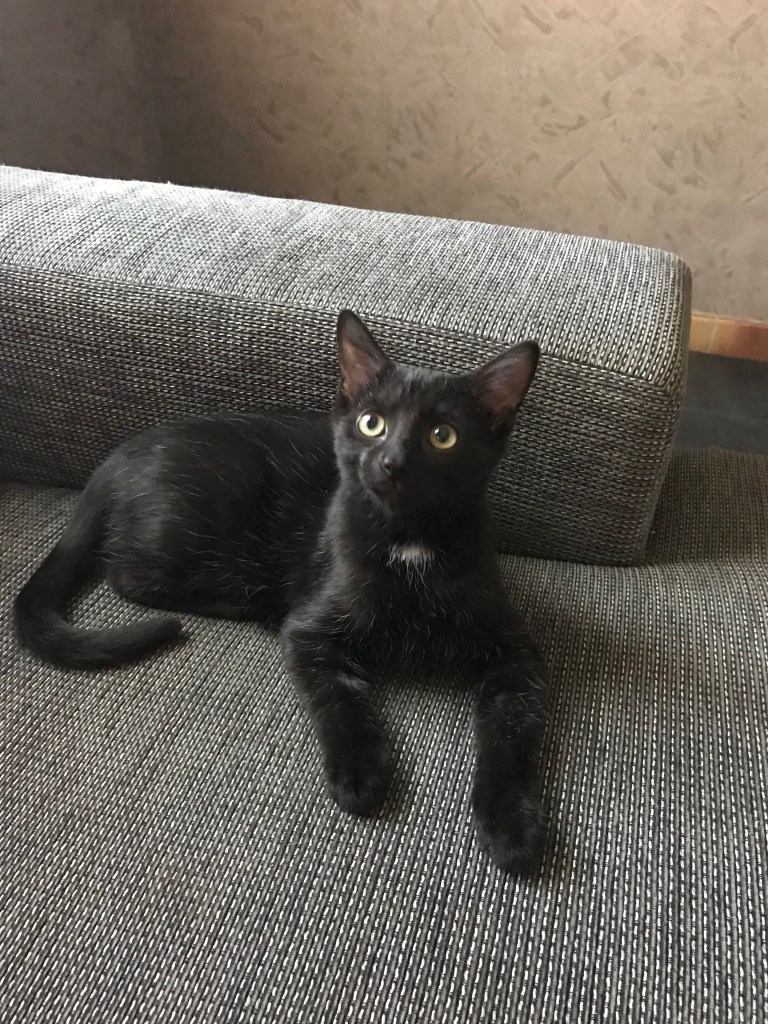
We found them. Five kittens, skittish and scared, brought out into the open by the presence of their mama. I got them trapped in short order. I brought them home, got furiously bitten by one of them, and cried with joy knowing they survived.
I got to work. They were so young, maybe six to seven weeks at the most. Only a little time hanging out with them and they were no longer afraid of me. Four boys and one shy little girl. One of the boys was smaller than the rest and sickly. But he was fearless. Every time he pooped all over himself and had to be cleaned up in the bathroom sink, he bounced right back. Many was the time he climbed up my pants leg in eager anticipation of dinner! He tried to sneak out the door of the room they were in, and he annoyed his siblings to no end.
Eventually, all the kittens were accepted in no-kill associations and adopted. All except the sickly one. He ended up with a wobble to his walk, perhaps the result of one of his fever episodes. I named him Liam. He is no longer little and sickly. He loves to eat and play and annoy his adopted feline siblings.
Sometimes doing good goes wrong, but things work out anyway.
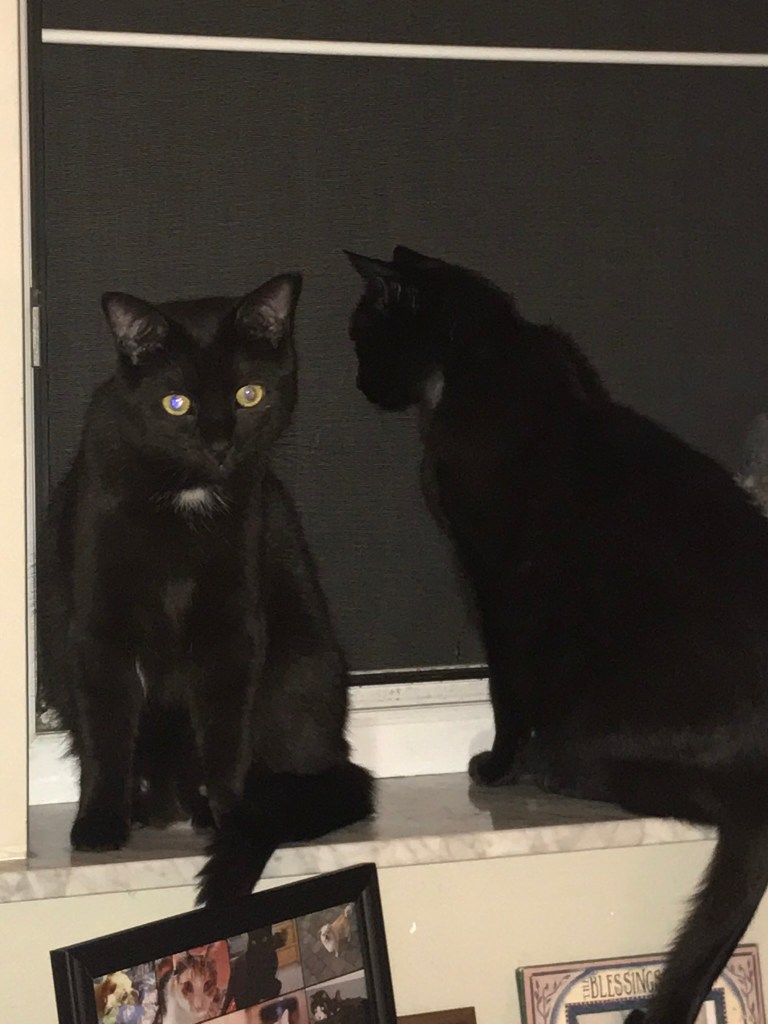
Update : this is a post written years ago but never published. It is time. Liam is now eight years old, and sweet George has crossed the Rainbow Bridge, and I am eager to see him again. Maggie and Gwen returned to the USA with me and Liam (pictured below in our new home) last summer.
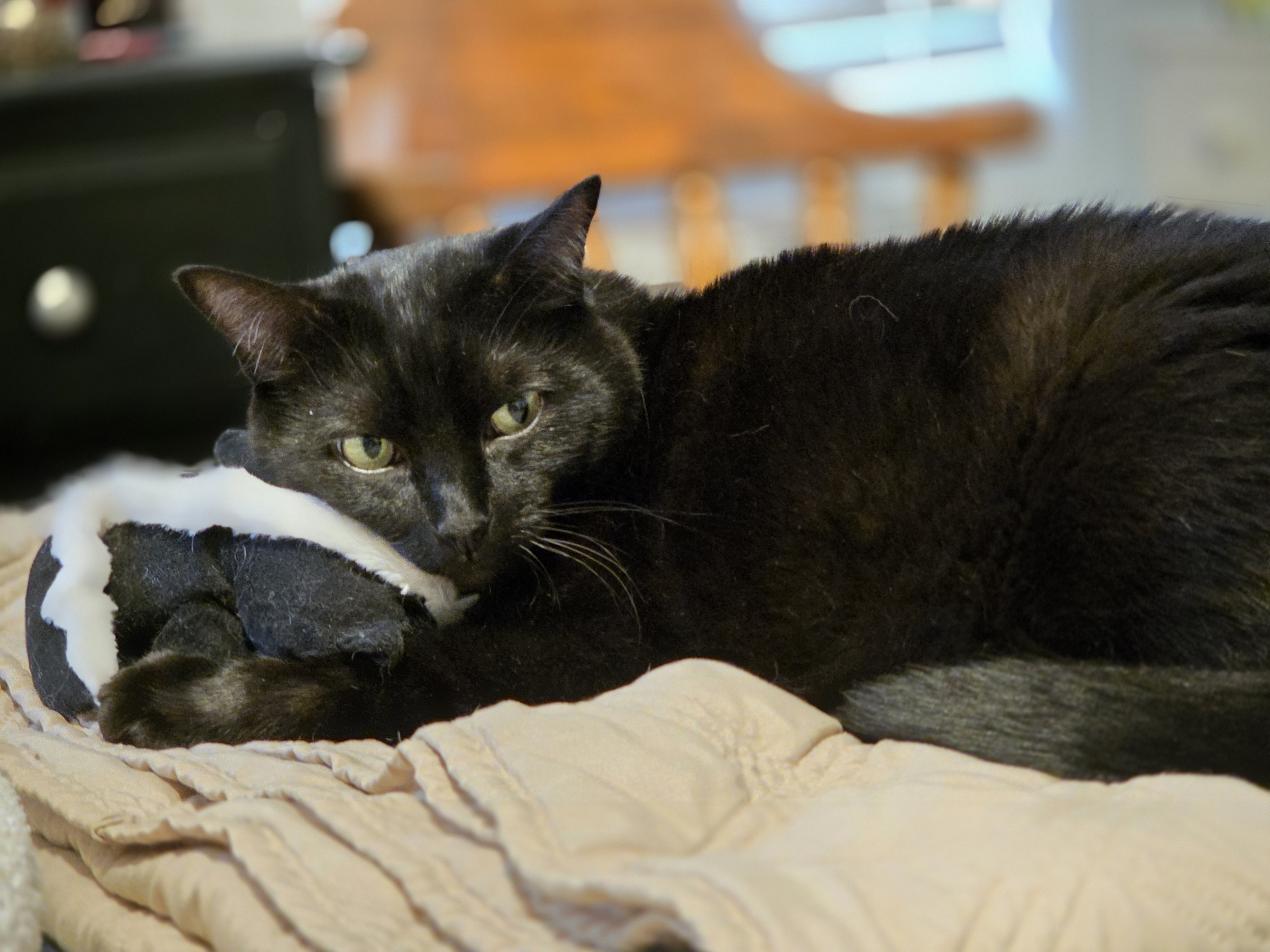
I am grateful for the happy ending.
 What Living Feels Like