A Letter to the World, Part 1

Dear World,

Many of my fellow Americans and I are mortified and deeply sorry for what is happening right now. We know the US government is destabilizing the rest of the world, as well as our own country, and if we could change it, we certainly would. Unfortunately, it is extremely difficult to change when the guardrails that we counted on for 250 years have been largely demolished by the “move fast and break things” principle that characterized the first several months of the current regime. We still have hope, but ordinary Americans are almost powerless. Outside of protesting, calling and writing our congressmen, and voting when we can, we can’t do much to change things.

I do want to explain some things to those of you who may think, with good reason, that the run of the mill American has lost his mind. I’d like to help clarify how we managed to elect for a second time a convicted felon, someone who stole classified documents and stored them in a bathroom, someone who was even then suspected of sexually abusing children. It seems so impossibly stupid, and obviously it is, but there are reasons and events that led us here. I’m still trying to understand some of the statistics, so I’ll save most of those for part 2, but here is what I think is most significant. And please understand, I don’t have expertise in these areas; I am speaking from the point of view of someone who has observed, read, and watched, and who is appalled by the current situation.

First, our country is steeped in racism and misogyny. The election and reelection of Barack Obama ignited the ire and the contempt of overt racists, as well as quiet ones, those who don’t think of themselves as racist but for whom a black person could only be elected because “of course, 100% of black voters and far left liberals turned out to vote for him.” Obama’s election and subsequent mostly successful presidency was unforgivable for the white racist element, and this is evident in the conservative embrace of the most racist president in modern history, who has inspired and emboldened the worst among us. The idea that a black WOMAN could be elected is so far beyond the pale for this relatively large group of people that they could never vote for her, and the issue with Harris’ gender extended even to minority groups. So deep runs the racism and misogyny that of the registered voters who actually turned up and voted, only 47% of white WOMEN voted for her, choosing a misogynistic white man over a woman of color of their own gender. Only 39% of white men voted for her, only 48% of Hispanic men, and only 52% of Hispanic women. Add to that the fact that fully 21% of male black voters voted for Trump, and you simply have to conclude that a woman cannot be elected to the presidency in this country at this time. (Statistics taken from Pew Research.)

Second, right wing media has brainwashed many Americans. Until the 1980’s, the Federal Communications Commission operated under what is known as the Fairness Doctrine. It required that in any news broadcast, when a controversial topic was addressed, both sides of the argument had to be presented. If you heard the positive argument, you would also hear the negative. This is a simplified explanation of the doctrine that actually encompassed several rules which together ensured that American media was not politically biased, or at least not very much so, and that we heard the truth of what was happening in the world. In 1985, Ronald Reagan’s commitment to deregulation wherever possible created an environment where the Fairness Doctrine was denigrated and said to no longer be serving the public interest. The eventual abandonment of the Fairness Doctrine opened the door to Fox News, Rush Limbaugh, Glen Beck, and the like. As a result, we now have whole media conglomerates that cater to the far right. In the past 28 years of Fox News, it has become a propaganda machine dedicated to disseminating far right, even extremist, policies, often marketing outright lies. The beautiful women and provocative men who call themselves journalists and serve as talking heads for the company are powerful draws for those among us who are less likely to tune in the news to be informed, and more likely to watch for the entertainment value. At present, most Americans ONLY watch, listen to, or read news that is likely to agree with their political leanings, and we distrust the media outlets on “the other side”. We are now the most divided nation I have ever seen. Even the Flemish and Walloon Belgians are more united. (To read more about the impact the loss of the Fairness Doctrine has had on the USA, click here.)

Lastly, shame on the previous administration for a couple of important things. First, for not passing a law forbidding a convicted felon from running. And second, for not exposing everything in the Epstein scandal during those four years. As much as I appreciate Biden for some of the things he accomplished, these two non-events led us to this situation. I would also add his tardiness in deciding not to run for reelection, but it seems a non-issue based on the misogyny noted above, UNLESS there had been a primary, where a different, less FEMININE (ahem!) candidate might have presented himself.

So World, please forgive the Americans you run across. There are so many of us, without question a majority of us, who do not support what our current federal government is doing. Those of us who travel, whom you might meet in your countries, are even less likely to support the administration, and almost certainly didn’t vote for the current president.

Part two will follow as soon as I can digest the statistics.

For now, just we are SO SORRY.
When Doing Good Goes Wrong (in the short or long term)

I was just trying to do good. As I always do when I’m spaying or neutering a stray cat or a feral one. This time it didn’t go the way that I wanted it to. 

It was Spring, 2018. The lady who’d been feeding the cats on the base where I worked in the south of Belgium let me know that there were two pregnant females. The Société pour la Protection des Animaux and the private no-kill rescues were all overrun at the moment with cats and kittens. I knew that we had to get them and either spay them (aborting the babies) or let them have the kittens in security and safety and keep them from being wild, or at least help them to not be too frightened to be adoptable. 

This was already about to be a nightmare for me, as I pride myself on what I call my consistent life ethic. I am vegetarian, anti-death penalty, anti-zoo, anti-vivisection, pro-immigration, and anti-abortion. And as to the latter, I’m not what’s come to be known as an anti-birther; I want to take care of babies that are born, somehow, and well. So knowing that on the table was the distinct possibility of aborting kittens was already tearing at me.

On Thursday evening I arrived at the site before their caregiver. A couple of days before, she had told me where the more fearful one would appear, and I set the humane trap there. I withdrew from the area and sat in my car about 100 meters away from the trap; this was a cat who didn’t come very close to her caregiver. I could just see the trap, as it was dusk and pretty far.

Soon I saw a long-haired black cat approaching the trap. Baited with fresh sardines, I knew that if she was hungry, she would go in. Sure enough, I was shortly rewarded with the distinctive clap of the metal door closing. I grabbed a large towel from my car, ran to the trap, and covered it with a towel because I know that the cat will be less panicky if she can’t see out of the trap. I took a brief peek at her, but she was balled up in the corner as fearful cats tend to do, so I really couldn’t see anything except that it was indeed a long-haired, black cat. I called her caregiver, who was on her way to the site to pick up the other one, a far less fearful short-haired black female. I headed home with the little black cat in the trap.

Shortly after my arrival, the caregiver arrived with the other less wild one in a carrier. We discussed next steps. She was against spaying them immediately; she wanted the cats to be able to have the kittens. Her husband was of the other, more practical, mind. As she is the caregiver, I did not want to do something against her wishes, and of course I was grappling with the reality of killing kittens in their mothers’ wombs anyway. We decided to give it a couple of days to think about what would be best. I put the cats in my “cat room” where they would be safe and where I could look after them well.

Over the course of the next few days, we talked regularly, the caregiver and I. On Sunday, she let me know that she thought it would be best to have the cats spayed immediately thereby ending the lives of the kittens. She had done some homework and found that this is the common solution when the shelters are full. I had expected that this could happen, so I had called on Friday and set an appointment for both of the cats for Monday morning with my vet.

On Monday evening I arrived at the office of my Belgian vet to pick up the cats and bring them home for their recovery. The veterinarian’s mother, who is her assistant, came out and said something in French that I asked her to repeat. “The longer haired one was not pregnant; she already has kittens somewhere. She had a litter of kittens five or more weeks ago.” The look on my face must have communicated volumes. “Mais oui,” she responded.

My heart dropped. 

A few minutes later the veterinarian emerged from the treatment area. “She had probably five or six kittens she said, at least five weeks ago. Maybe longer, but at a minimum five weeks,” she told me. “I can tell by the way her uterus has gone back into shape that it has to be at least five weeks.” By now I’m practically sobbing. “They can’t survive this long, can they?” I demanded. “It’s been since Thursday that she’s been away from them!”  The veterinarian grimaced. “If someone is feeding them, perhaps. But it has been quite cold.”

“By now they’re likely dead,” I admitted. The veterinarian’s facial expression told me she thought I was right. I rushed home, called the caregiver on the way (who was as devastated as I was), dropped the two cats off to my cat room for at least a day or two of recovery, and rushed back to the base where I spent the next hour and a half walking in the fine misty rain, near where I had trapped the momma cat. It was nearly dark, and the area is filled with possible hiding places. 

Shining my flashlight under the many small buildings, in the brush, amongst the new Spring growth in the light wooded areas, I searched, looking in vain for the glow of eyes or furtive movements. 

In the following days, I repeated the walk, drove around the area, asked for info on the local Facebook page, and banged on a door after hours so I could talk with the people inside the building who had placed a dish of cat food outside. No one has seen any kittens. Cats, yes. Kittens, no.

More than likely, with the cold, they got hungry, and when mama didn’t come back, they snuggled up in a pile and died of hypothermia. I didn’t know this for certain, but it was the most likely outcome. 

At the moment I was having a hard time forgiving myself. The poor mama cat must have been wondering what happened to her babies. Yes, I know animals mourn. I am sure she was mourning…her babies and her lost freedom.

The caregiver adopted the less wild one, Lily. I called the wilder one Mama Rose. She remained in the cat room for the next ten days so I could try to socialize her in the hope that she might be adoptable. Alas, it was not to be. She was too traumatized and frightened, so I released her where I’d caught her, where she’d be fed and have familiar places to hunker down in the weather. She regained her freedom, but she will never regain those babies.

And then, a few days later…

We found them. Five kittens, skittish and scared, brought out into the open by the presence of their mama. I got them trapped in short order. I brought them home, got furiously bitten by one of them, and cried with joy knowing they survived.

I got to work. They were so young, maybe six to seven weeks at the most. Only a little time hanging out with them and they were no longer afraid of me. Four boys and one shy little girl. One of the boys was smaller than the rest and sickly. But he was fearless. Every time he pooped all over himself and had to be cleaned up in the bathroom sink, he bounced right back. Many was the time he climbed up my pants leg in eager anticipation of dinner! He tried to sneak out the door of the room they were in, and he annoyed his siblings to no end.

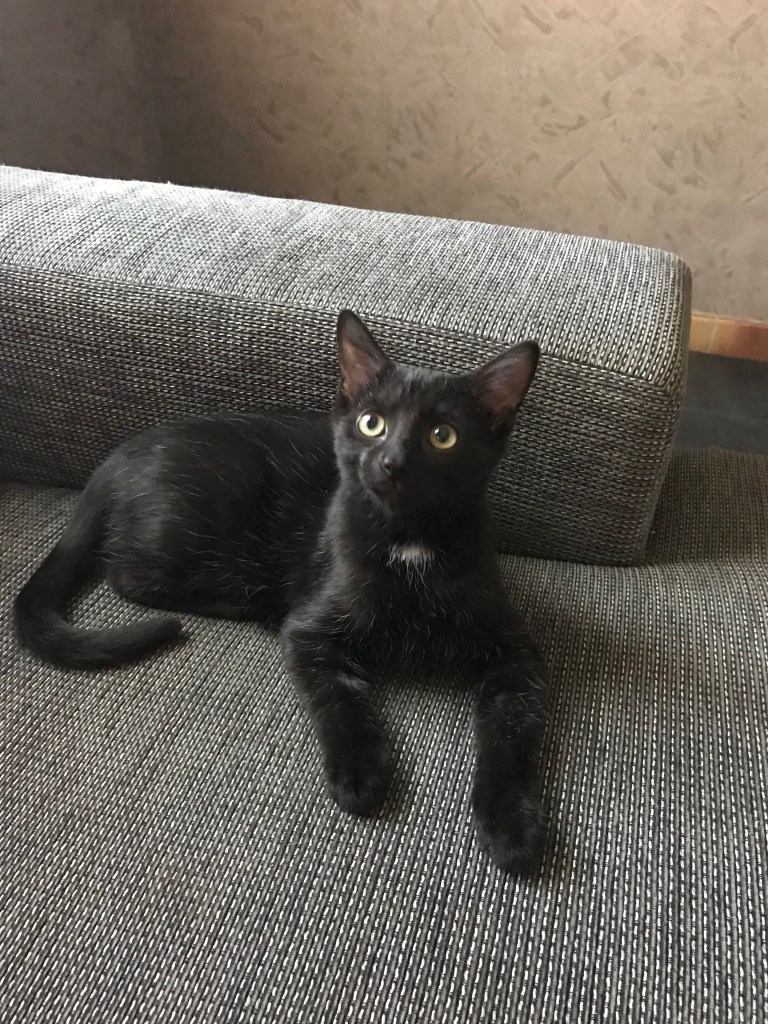
Eventually, all the kittens were accepted in no-kill associations and adopted. All except the sickly one. He ended up with a wobble to his walk, perhaps the result of one of his fever episodes. I named him Liam. He is no longer little and sickly. He loves to eat and play and annoy his adopted feline siblings.

Sometimes doing good goes wrong, but things work out anyway.

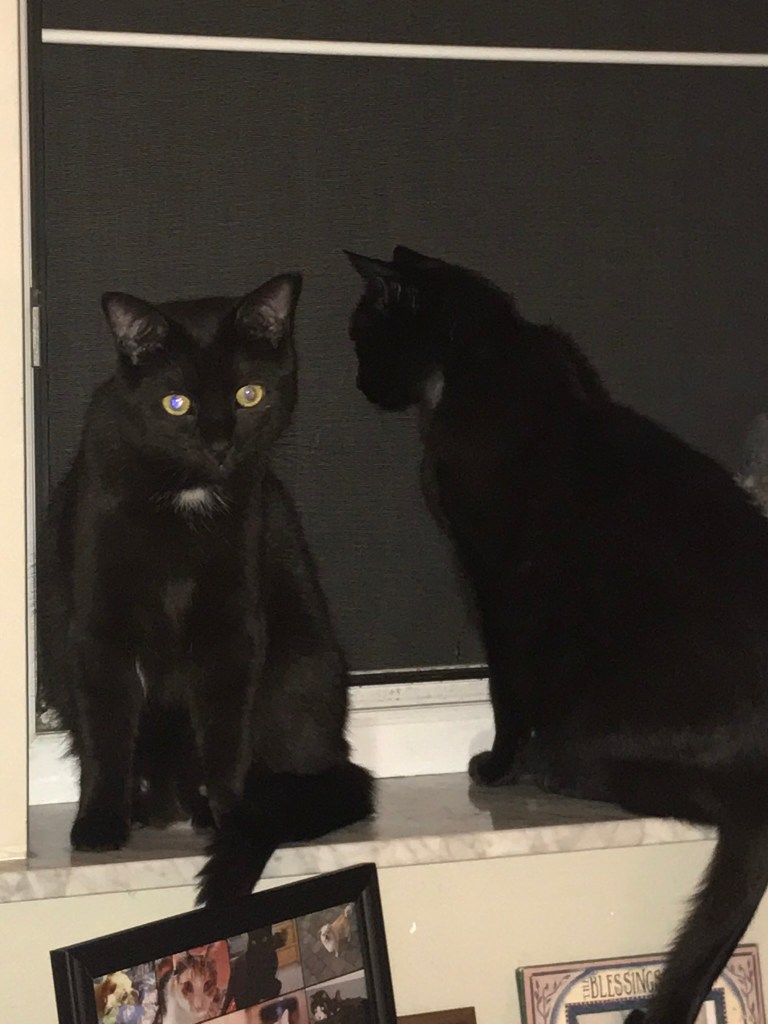
Liam facing the camera. That’s his older adopted brother George looking out the window.

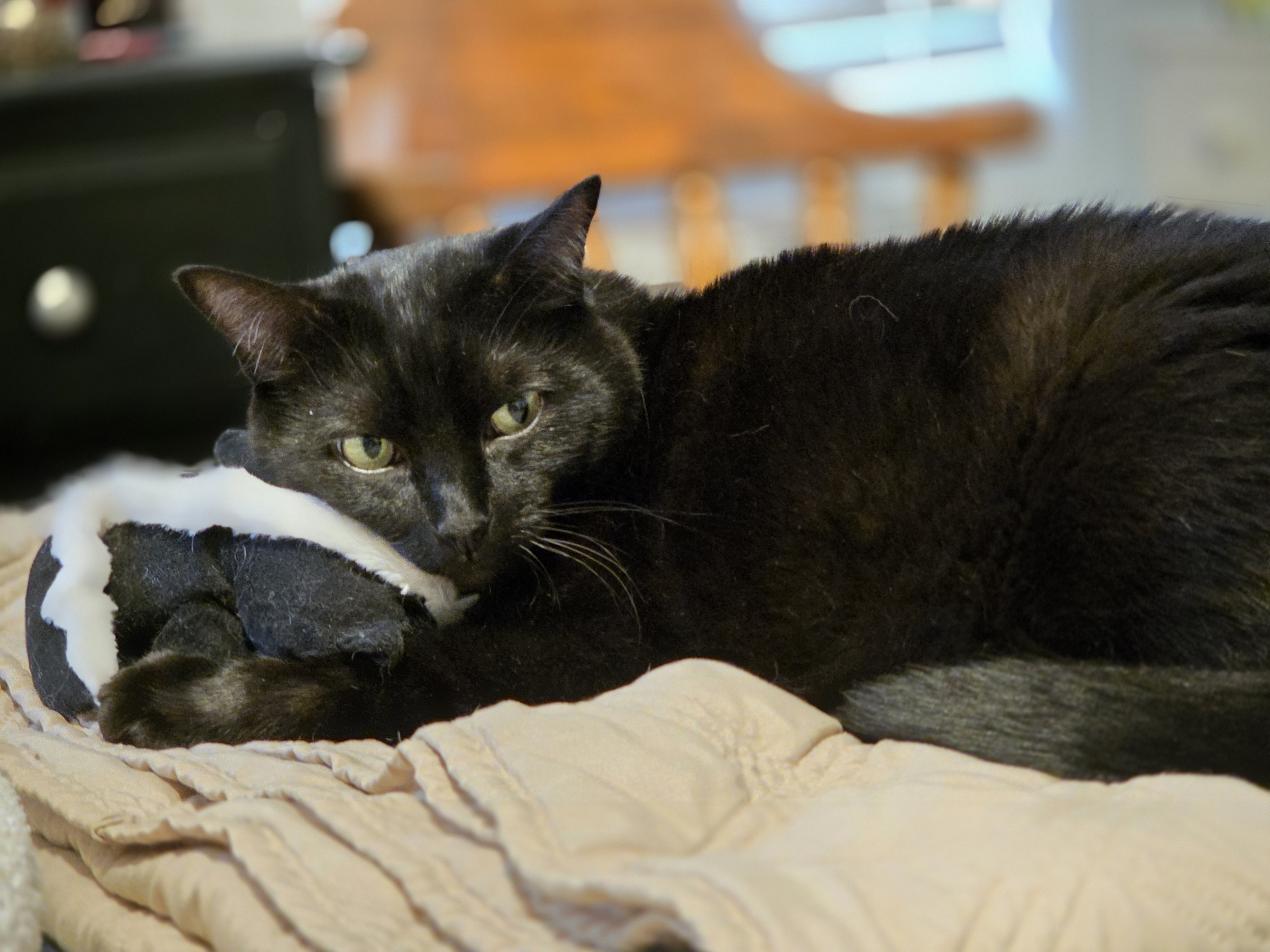
Update : this is a post written years ago but never published. It is time. Liam is now eight years old, and sweet George has crossed the Rainbow Bridge, and I am eager to see him again. Maggie and Gwen returned to the USA with me and Liam (pictured below in our new home) last summer.

I am grateful for the happy ending.

Community Theatre is “Amateur” Theatre

Another opening! Another show!

If you heard that in Ethel Merman’s voice, you are my people. Fellow drama queens (and kings). Not in the sense that regular people use the term, but in the amateur actor sense. I have been walking the boards in North Carolina and Belgium for over 30 years now. Often I do two shows a year, some rare times, I have done as many as three. It’s a commitment to performance art and to the other people involved that is far beyond what most people might think, but very unlike the commitment that Broadway and West End actors make. And that is what prompted this post.

When I go to Broadway or the West End to see a show, I am wowed every time. The people up on that stage are just beyond description; they give their all every performance, and they leave you breathless, speechless. You walk out of the theatre simply buzzing, your head full of the images and sounds you have just experienced, your whole body practically vibrating. When you go to your local theatre and watch your friends and neighbors up there… it generally isn’t quite the same. They may give some incredible performances, and you walk away thinking about how wonderful they were in the roles. Most of the time, it looks perfect to the audience, no errors noticeable, and the sets and lighting and music and performances are very good. Once in a while, you notice a little something that doesn’t seem quite right, and you wonder what just happened, but then you forget about it, because you get right back into the show. It’s a fun night out. But let’s face it, rarely do you leave a community theatre on the same high that you do when you are in New York or London. I know you don’t consciously think it, but in the back of your mind is the thought that the local actors are good enough for the local stage, but nobody in your community is Nathan Lane or Patti Lupone.

Let’s talk about that.

If you work as an actor or dancer on Broadway, according to Playbill, you work according to equity rules, typically eight hours a day, five to six days a week. This continues for five to eight weeks, sometimes longer, even much longer, if the show is a musical. You may work with a musical director, a choreographer, a vocal coach, a song coach, a dialect coach, and an acting coach. Then the week before opening, you work up to 12 hours a day for six days for Tech Week, known in the business as hell week. For all this you are paid a minimum of 2439 dollars a week, according to Backstage. Most shows play elsewhere for what are known as out-of-town tryouts before coming to the main stage on Broadway. And they play for months and months, so by the time you see the show, those actors can do it in their sleep.

Contrast that with your local community theatre. There is one director, and if it is a musical, there is one musical director and hopefully a choreographer. If you are very lucky, there is a vocal coach for the singers. Some of these people, if not all of them, are volunteers. There is a guy or gal who runs lights, and he might also run sound, but again, if you’re lucky, there’s one for each, again, almost certainly volunteers. The set designer might be paid but is more often a volunteer who depends on a team of other volunteers to build the set and bring his vision to life. The actors, also 100% volunteers, come to the theatre after work and rehearse two to four hours a night, then go home, fall into bed, and come back the next night and do it again. They do this for four to six weeks. They MIGHT come in on the Saturday before opening for a tech day, often an exhausting eight-to-ten-hour day of costumes and makeup and standing under hot lights so the lighting and sound is just right. Then the week of opening, they rehearse in full costume and makeup every evening, running the show to fine-tune transitions from scene to scene and every little detail of the show. Most directors, usually the only paid person in the equation, try to get the actors out of the theatre before 10 pm so they can get some rest before they have to go to their actual jobs the next day. When they open, they are performing for the first time for an audience, and they will get to perform the show three to nine times, then it is done. When you see the show, they have only performed it a few times for an audience, and in its entirety only a few other times in rehearsal.

I’ve worked in community and regional theatres with some of the best actors on the planet. Actors almost no one will ever see and whose name will only be remembered by the people who love them. They are local clerks, kennel managers, postal workers, teachers, secretaries, soldiers, housewives, paralegals, and even an army chaplain! Some of us have had formal training, but most not. Some of us have done a scene study or two in our lives, to try to get better at this “hobby,” to do justice to this love of theatre and performing. But we are amateurs, not professionals.

Why are those of us that are supposedly so darn good working in anonymity instead of being rich and famous, you ask? Some would say we lack the drive or ambition. Some would say we aren’t beautiful enough. Some might even say we aren’t as talented as we like to think. After much reflection, I would say some of those things are likely true. But more than that is the truth of what we gain by choosing to be and stay amateurs: family, freedom, and normalcy. We don’t want to uproot our lives and live in a big city, and we want to do other things besides being a famous or semi-famous actor. We don’t have to be away from our loved ones for weeks at a time, and we don’t have the “grand publique” pulling us left and right, expecting to get a piece of us, and expecting certain behaviors from us. We can eat in restaurants and go to concerts and be in public without interference. We can gain a few pounds and look our age, and everything is fine.

Then there is the question of values. I used to have a dear friend with whom I went to church who was a star on our local theatre stage in Asheville, NC; what a singer that gal is! I once asked her why she didn’t go to New York; she could have made it on Broadway with that voice. She considered it once, she said, but then she realized that to support herself, she would have almost certainly had to take any and all the roles she was offered, at least at first, and she would have probably had to compromise her values. By being an amateur, she could take the roles she wanted, love what she was doing, and be respected locally for her talent. That hit home.

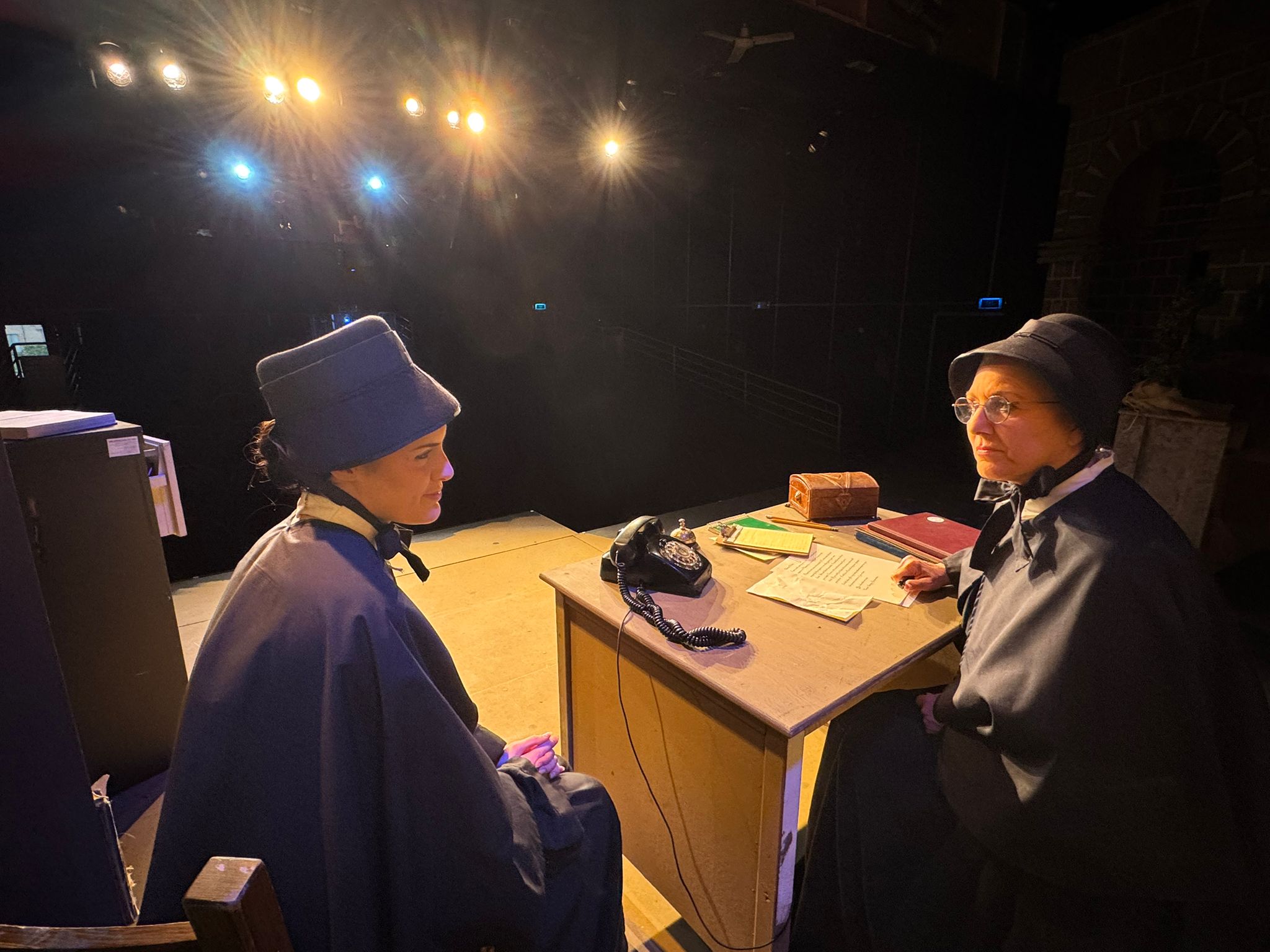
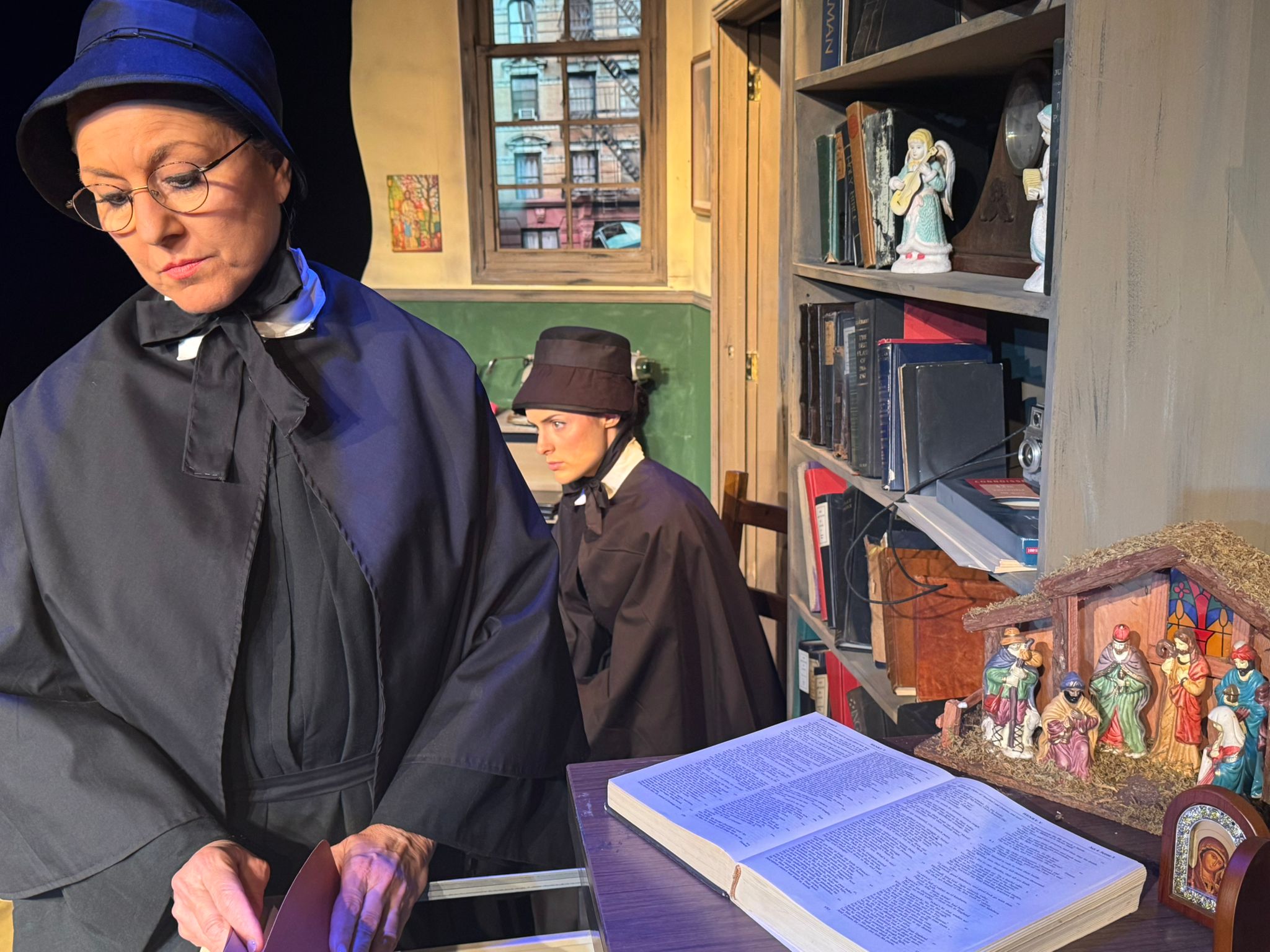
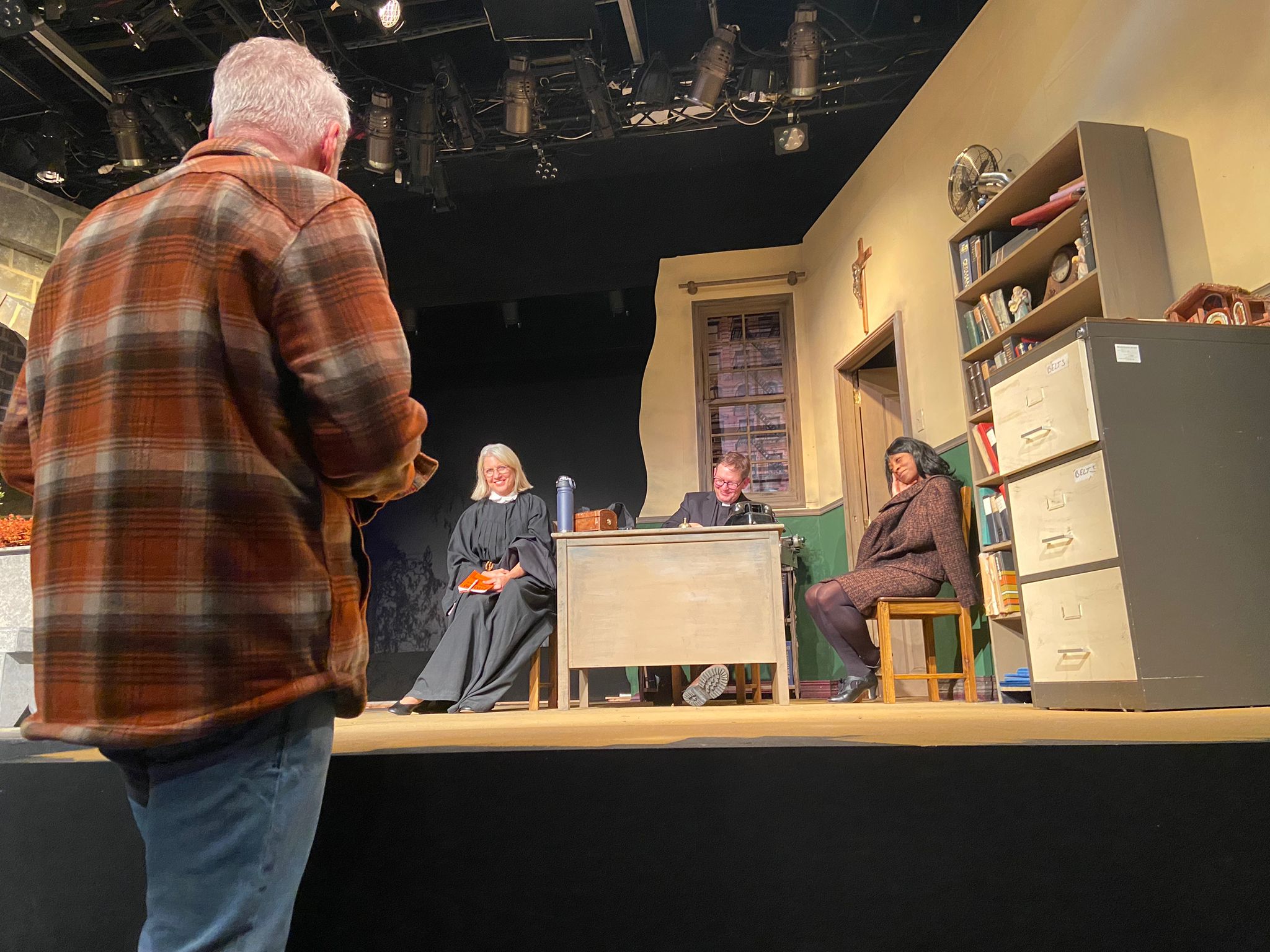
Right now, a very small, very talented group of amateur actors are giving some pretty darn exceptional performances on a tiny, obscure stage in the corner of a small cluster of buildings in Belgium. We are performing Doubt, an 85-minute drama that plays without an intermission, and leaves you with more questions than answers. Meryl Streep played “my” role in the movie, Tyne Daly on Broadway. I love our performances. We are serious and determined, and we are kicking some acting a**. We are getting rave reviews from the handful of people who are seeing us perform, and we all feel so blessed to be able to do this provocative and hard-hitting show.

Also right now, in tiny local theatres all across the world, similar groups of people are also rehearsing and getting ready to present their talents on those small stages, to audiences made up of their friends and neighbors. Most of them are also kicking a**. They are very good at what they are doing, and they are loving doing it. It is exhausting them, but invigorating them, and making them feel proud of using the gifts God gave them.

Next time your local community theatre puts on a show, go see it. Support the local arts community and remember to think about how little time they have had to rehearse and to develop their characters. Give them some praise, sure; but more importantly, give them some respect. They have done in a matter of a few short hours of rehearsal what those equity actors you rave about take four times that (often more!) to do. The talent among those amateurs is GLORIOUS.

Patti Lupone, I’m not, and never will I be. I’m me, Sunny Boone, dedicated to my craft, just as she is dedicated to hers. And I bet she’d like my performances.

Amateur: from the French, one who loves something, one who does something simply for the love of it, without being paid.

Life in a Small Town?

In the interest of honesty, I will admit that I started out liking Jason Aldean’s song Life in a Small Town. I liked it because at first glance, I thought that the values of taking care of each other, respecting authority, loving our country, and so on are true. Then I started thinking about “true for whom?”  Again, because I value honesty, I have to admit that I was helped along in thinking about that by a few friends. So, I started reading a little about the backlash. Finally, I asked one of my friends who happens to be a very intelligent young man of color to give me his thoughts once he had processed them. George happens to be a former student who calls me “Mama Sol”; I am lucky to be one of his surrogate mamas. George got back to me the next day. His intellectual honesty was almost shocking.

George said that as a black man from a small town, he recalls hearing that very sentiment, from blacks as well as from whites. And he loves how people do often come together to help one another. Then he reminded me that the song would have had a terrifying meaning 60 years ago or more when lynchings were happening, noting that Jason Aldean’s point of view is rightly that of a white man surrounded by like-minded people. He admitted that it is hard for people to understand the point of view of the “other,” whether the other is the oppressor or the oppressed.

“Black and white culture in the South… has and always will be intertwined. We have been molded by the same landscape, and raised by the same mothers,” he observed.  But he keenly feels the vastly different experiences in that shared culture.

As a white person, I don’t understand fully what black people deal with. As a woman, I do know what it is like to be minimized, marginalized, condescended to, set aside, and abused. And as a human, I have empathy, and I can look at the abuse, torture, injustice, and death, and I feel some of the horror, shock, and outrage my brothers and sisters of color feel. I am appalled that I didn’t see it myself, I, who pride myself (in itself, the first mistake) on seeing the symbolism in music and literature. The song is an anthem for patriotism, love of family, and community. It is also a rallying cry for violence against those who don’t agree with those values.

One of the things I admire about George is he always so practical; he comes back to the basic truth of life. Let’s not stop with the protest for or against the song, but rather let it show us ourselves and our shortcomings. What we need are compassion and empathy. George reminds us that “what wins in the end is compassion, the willingness to understand, and love. Love always wins.”

Intermittent Fasting Update

My last post was near the beginning of my IF journey. I had lost five pounds in two weeks without much deprivation. It was encouraging! By the time school started again I was down three more pounds and was only four little pounds from my goal of 155 pounds or about 70 kilos.

School started about five weeks ago and I’m holding steady at that same weight: 159 pounds. But that means that it has been five weeks and the goal weight is still the same four pounds away. I’m not discouraged, though because this has been a heckuva start to the school year, the most stressful one I’ve ever experienced. Thank you, COVID and a rather — ahem! — INTERESTING administration! So the fact that I haven’t put the weight back on is a win.

At 159 pounds on my 60th birthday!

It’s also a win because it is much harder on the schedule we have at work to make the 8 hour window work. I have to really pay attention to timing, much more so than when I wasn’t working because there is very little flexibility with lunchtime at work. I also have to make sure that one day’s eating window doesn’t interfere with the next day’s, as sometimes I have lunch duty and it can get the timing off because I will have to either eat earlier or skip lunch altogether.

The other difficulty I am having is getting back to my workouts, which since before the end of summer… well, let’s just say that my motivation to work out in 85 – 95 degree weather (29 – 35 degrees Celsius) went down in heatwave-induced flames. Belgium is not known for hot weather so there is no air conditioning in my little house nor in most gyms. I know, I know; I’m a wuss, but it’s not my fault! As an adult I became accustomed to air conditioned American gyms!

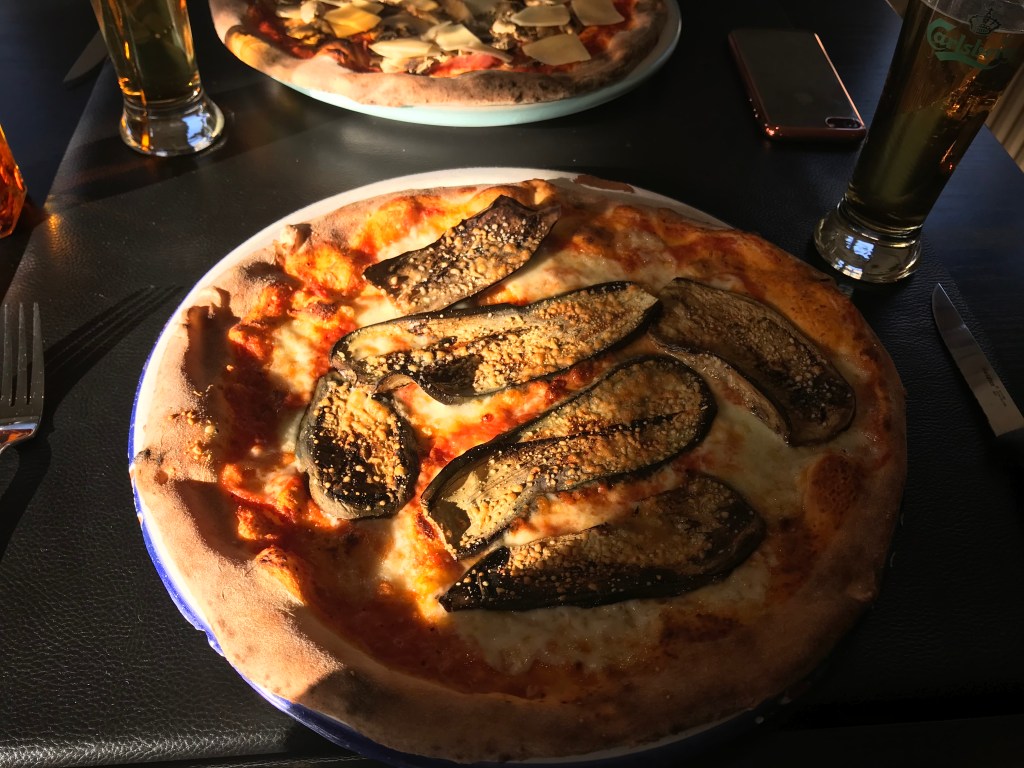
Finally, I had some bloodwork done recently, mainly to see where my cholesterol is since going almost 100% vegan. (In the interest of transparency, you must know that I am unfortunately NOT vegan in all my choices; I still eat cheese on pizza, and eggs from friends’ happy, dirt-scratching hens once in a while. I’d like to say those choices are very rare but… I really love pizza. I mean, REALLY. Especially parmagiana: roasted eggplant and parmesan cheese on a delicious thin crust… mmmm… oh, sorry ’bout that.)

Aforementioned definitely-not-vegan pizza

Anyway, I never indulge in that dirty little addiction more than once a week and usually no more than once every two to three weeks, so please don’t judge me too harshly.

In the past, I have tended toward slightly high cholesterol — 200 – 220. So I got my blood work back and guess what! I’m still right at the same place!!! 210!!! What the actual HECK??? Not happy with that, although the doctor isn’t alarmed. She says it’s most likely family tendency but she also mentioned pasta as a potential culprit. Wait…wha…what???

PASTA??? PASTA can cause high cholesterol??? NOOOOOOOOOO….!!!!

Turns out you have to choose whole grain pasta, which I sometimes do, but admittedly, not always. And here where I live, some of the tasty American choices are harder to get, and the choices I have aren’t always great. Also Thai food, which I love, uses coconut milk of course, and guess what? Coconut milk is very bad for you if cholesterol tends to be a problem.

Well, fudge. *sigh*

Looks like reading labels religiously is called for, and maybe sacrificing some of my favorite things in favor of keeping my cholesterol down. Maybe that, coupled with getting back to working out, will get rid of those last few pounds.

Goal for the coming week: three workouts.

Got advice for me? Please put it in the comments! I’d love to hear!

Thanks for reading!

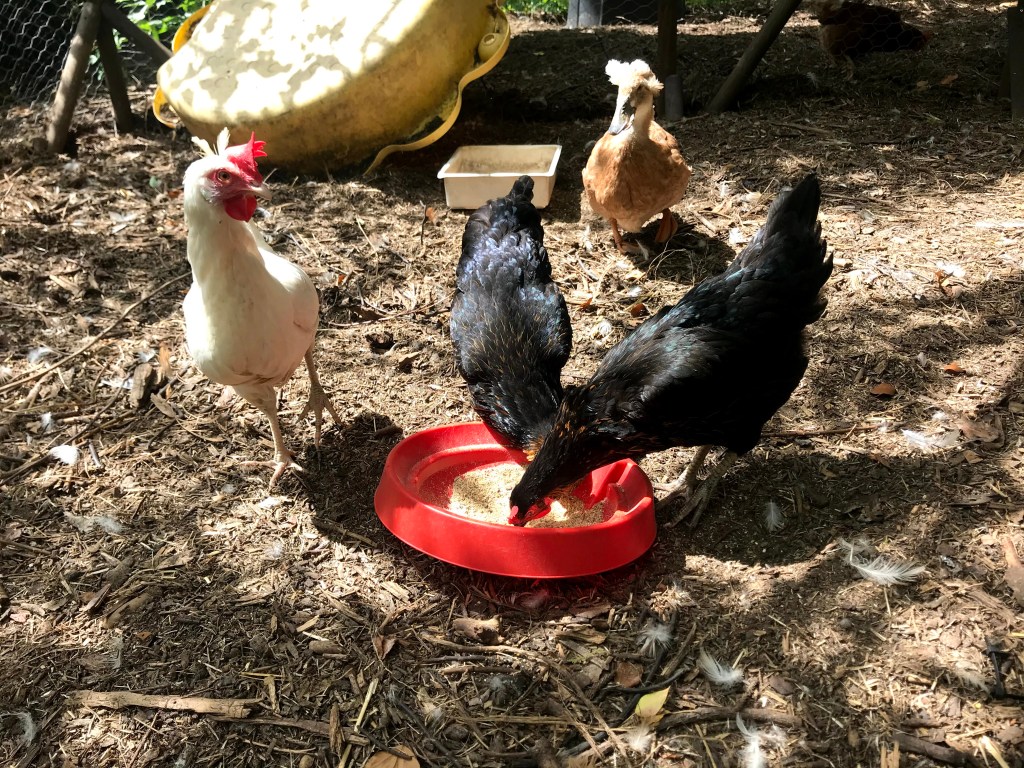
Some of one of my friends’ very happy hens.

The Saga of a Snacker

I love food. I love to eat. I’ve got a friend who sometimes forgets to eat. I remember Erma Bombeck once saying, “it takes a special kinda stupid to forget to eat.” I couldn’t agree more! I’ve never forgotten to eat in my whole life. Pizza, pasta, potatoes almost any way you want to make them, fresh-from-the-garden tomatoes and cucumbers, pinto beans and cornbread, creamed spinach, French toast, fresh green salads, vegan hot dogs, vegan sausages, vegan burgers (I’m vegetarian, most of the time vegan, but that’s another subject), cornbread and plant milk, frozen blueberries in oatmeal, Poke Bowls, burritos, tacos, chiles rellenos, southern-style biscuits, garlic and oil sauce, buffalo sauce, green chile sauce, balsamic fig oil…(sorry, is that my stomach growling?) Honestly, there is only a handful of foods I don’t like. I like almost everything.

You’d think I’d weigh a lot more than I do, the way I love to eat. And I do eat kind of a lot. Always have. Must be the southern upbringing with MaMaw always in the background, “You hain’t got nothin’ on yor plate, git you somethin’ else, now.” Meanwhile, the plate groans under the weight of the food piled on it.

Luckily, I’m blessed with a high enough metabolism and a 5’8” frame to offset some of that. But not all of it. In early high school in Germany, I got up to nearly 140 and that was pretty chunky for a high school kid. But did you know that in the ‘70s, you could get actual amphetamines from the German pharmacy without a prescription? Well, guess what? In the summer of ’75, my mom’s house was spotless and I lost 20 pounds! I didn’t get a lot of sleep, however…

I stayed at about 120 – 125 pounds (around 55 kilos) well into my twenties, when my weight inched up to about 145, and I lost a few pounds with Weight Watchers. I managed to stay under 150 (about 68 kilos) until I quit teaching for a while to sell real estate and discovered appletinis and cosmopolitans; ethanol is delicious when you put enough sugar in it! That was when I hit my highest at 181 (82 kilos!) but of course, who notices when you’re half sloshed? I lost most of those extra pounds when the real estate firm I worked for did a “biggest loser” contest and my real estate partner and I took the grand prizes for most weight lost and most fat lost, respectively; nothing like 500 dollars in prize money to get me motivated!  Got pretty fat again when I moved to Belgium and “HELLOOOO, Belgian beer and chocolate!” Not to mention FRITES! Nearly hit my record high again but managed to get down to 160 (72 kilos) and kept it off for a while. I felt like I couldn’t go any lower, and I probably can’t go much below that at my age NOW – I turn 60 next week. But 160 on my frame isn’t bad, really, and a few extra ounces in my face is actually a plus! (You ladies of a certain age will surely understand what I mean.)

Me after a year of Belgian beer and frites.

But my weight still tends to inch up, because, FOOD. YUM. (See introductory paragraph for details.) And presto! COVID-19 happened and I was back up near 170 again. I know I can lose weight if I cut out all carbs except for one meal a day, but in the words of one of my oldest friends, life is not worth living without bread. Especially in Europe, where bread is DELICIOUS: baguettes, schwartzbrot, croissants, fitness bread, panini, ciabatta, Swedish crisp bread… sorry, I digress.

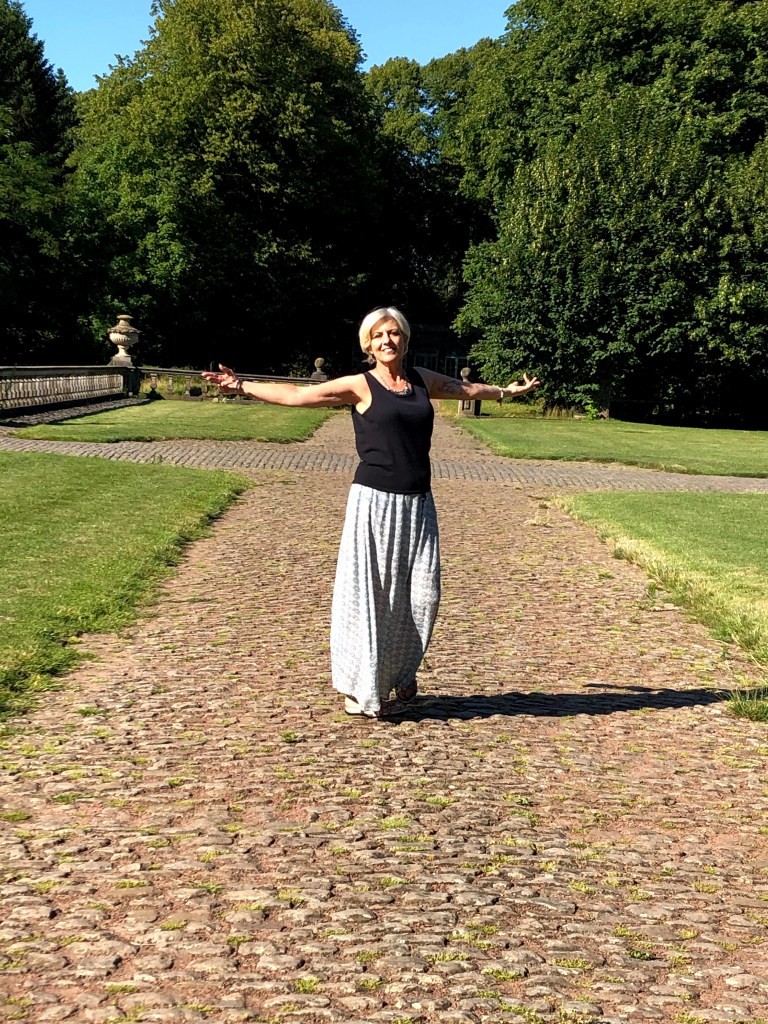
Me at 160 pounds in Summer of 2019. Horizontal stripes, no less!

So I started reading about Intermittent Fasting. This is simply giving yourself a window to eat and fasting on water and unsweetened coffee or tea during the other hours. There are a lot of eating patterns that involve fasting intermittently, but the most common ones are fasting for 16 hours and eating two to three meals during the other eight or fasting for 18 hours and eating two meals during the other six. Apparently the body the body undergoes some interesting changes when you fast for 15 to 24 hours:

  1. Insulin sensitivity changes makes your stored body fat more easily accessible as energy.
  2. Human Growth Hormone levels go up, making fat loss and muscle gain more likely.
  3. Cells begin repair processes.
  4. Blood pressure tends to improve.
  5. Thinking and memory tend to improve.

I was more interested in numbers one and two, but hey, I’ll take the other three for sure.

One of my friends mentioned to me that I tend to snack a lot. Now, bear in mind this is the same friend who sometimes forgets to eat, but in spite of that, she is actually pretty smart. At first, I went, “no, I don’t, not any more than anyone else.” But she insisted. I still resisted but it ate at me a bit, so I took a look at myself and it seems that yes, I do snack a little more than some people. Okay, maybe more than a little more. Okay, OKAY, a LOT more than MOST people. Geez, I can’t get away with anything! Anyway, one of the things I learned in doing my research on IF (Intermittent Fasting) is that when you eat three meals a day and snack from time to time, your body is always using your recent calories as energy and the stored fat inside your body is never converted to energy. Never. Converted. to Energy.

WELL THAT EXPLAINS A LOT!!!!

Phooey!

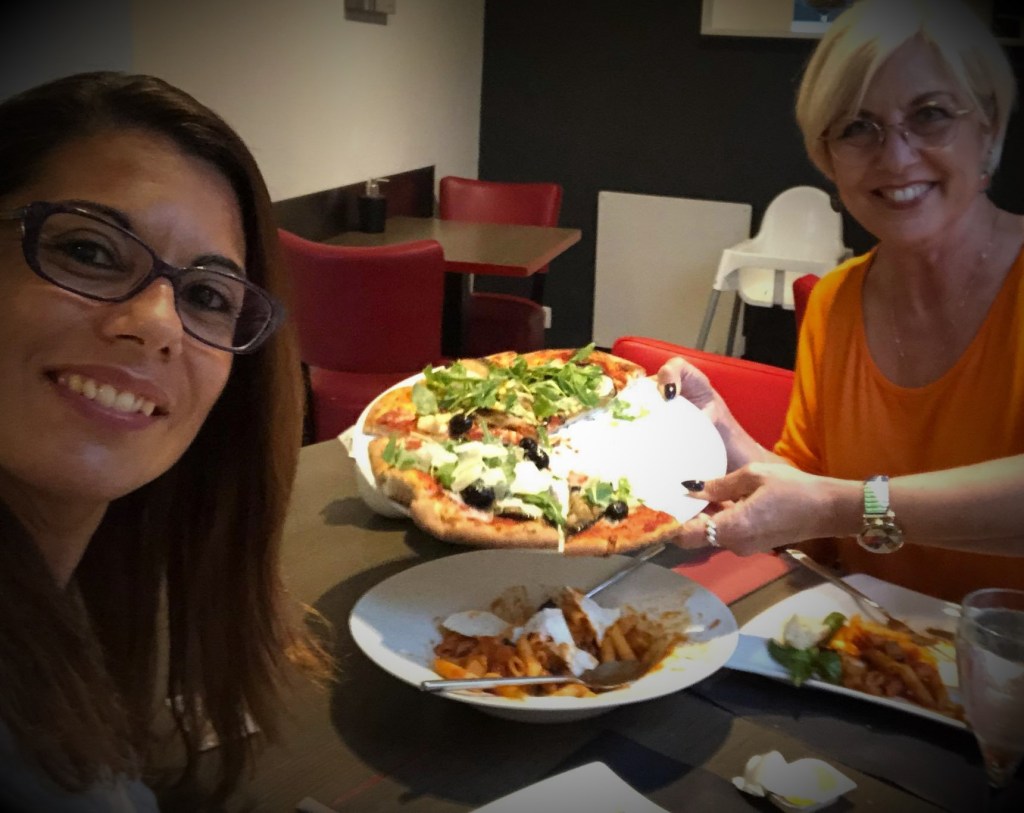
So I decided to give it a try. Two weeks ago I was at 167 pounds after having put on the quarantine seven. I jumped right in to IF with the 18:6. Most days it isn’t too hard to do an 18:6 fast; finish dinner by 7 p.m., no snacking before bed, then rise and shine, black coffee, water, and no food until 1 p.m. Sort of like just skipping breakfast. It got a little tougher when I couldn’t have dinner until later, but I just do a 16:8 fast on those days, and once I did a 15:9, which interestingly is said to be optimum for some women. I eat pretty normally although I’m trying to choose healthy foods, with lots of vegetables and whole grains, aiming for 55% carbs, 30% protein and 15% fats. My calorie count tends to stay below 1500 most days; I track it using the free app My Fitness Pal. On the weekends it is higher because I usually eat out at least once and I don’t deprive myself for that meal except for skipping dessert. This past weekend it was a pizza and a plate of pasta split with a friend, so you can see, that is not deprivation at all. I even have a glass of wine a few times a week. The good news is I’m nearly never hungry except near the end of my fasting period, the last hour or so, maybe, and if I stay busy, it isn’t a big deal at all.

Does THIS look like deprivation to you?

I weigh myself nearly every day so that I can see trends, and my weight is consistently inching down. Today I am down to just under 162 pounds (73.5 kilos). Might not seem like much but bear in mind I am post-menopausal and it is notoriously hard for women like me to lose weight. So five pounds in just under two weeks is GREAT. I’m going to keep it up and see if I can get to 155 and keep myself there for a while. I’ll let you know!

References:

https://www.healthline.com/nutrition/intermittent-fasting-guide#effects

https://www.hopkinsmedicine.org/health/wellness-and-prevention/intermittent-fasting-what-is-it-and-how-does-it-work

https://www.healthline.com/nutrition/6-ways-to-do-intermittent-fasting#section2

George

I have a self-proclaimed son named George. Born of love, not of blood, he is a friendly, funny, and intelligent fellow, handsome to look at and easy to know, and someone who most consider “an old soul.” He came into my life in his tenth grade Spanish I class, which I was teaching. He discovered in my class that he is “good at” languages (fluent in Spanish by mid-year in level 2), and he got bitten by the travel bug on a trip with me to Spain. He’s now a flight attendant for United and we see each other from time to time, either here in Belgium where I live, or in NC where he’s from, or in an airport somewhere as we cross paths. He really is like a son to me. I love him with whole heart.

George is black. I’m white, if you don’t know. Or sort of peach colored, anyway.

Today another George was killed. By a white police officer while many others looked on. George Floyd was being arrested for a white-collar crime, and by all accounts, and by what video I have seen, he was neither violent nor did he resist arrest. Even if he had resisted, he died making his distress known, pleading for air, the officer’s knee on his neck, until after his body went completely limp, for a total of more than seven minutes.

I can’t help but picture that as MY George. If it had been him in that situation, would he have been treated that way? I suspect he would have. And that scares me.

One thing I do know is if it had been me, a white woman, I would not have been treated that way. And it is a safe bet that my much younger white brother, tall, braw and blond, would have been handcuffed and gently placed into the squad car, his head protected. Even if my brother had resisted arrest, he would have been placed into the car and would likely not have been seriously hurt. He almost certainly would not have been handcuffed and put face down on the ground with an officer’s knee cutting off his airway for so long that he would lose consciousness and die.

What is it going to take for this to stop? Are we to make the black community pay for our sin of slavery and racism for the entire history of the great United States of America? And by the way, who the devil are the people who are raising people so lacking in empathy that they think it is reasonable to hold a calm and unresistant, handcuffed man down by the neck until he loses consciousness? That it is acceptable for a man’s pleas for air and mercy go unheeded? That an unarmed black man can be shot in his car (Philando Castile), in the back execution-style (Oscar Grant), or by vigilantes for jogging (Ahmaud Arbery)? These are only a handful of outrageous events that demonstrate the increasingly dangerous place that the US is for a black man, or even a black woman. Being black (or latino or native American) means your risk of being killed by a police officer is well over twice that if you are white.

Here in Europe, people think we must be the most racist country on the planet. After living here and having friends from lots of countries, I don’t think we are, but it is far more dangerous to be black in the US than it is here, maybe because most people here don’t have guns, and surely because most police officers know when NOT to use deadly force.

I pray for my George. As a law-abiding, taxes-paying black man in America, he is in danger every day. Every time he leaves his house, even when he is IN his house or his car, or at his job, he risks his life. His birth mama taught him to be polite, especially with officers of the law, and I remind him sometimes of how to reach for his wallet to show his identification to an officer who asks for it. I love my brother, too, but I have never reminded him of that; I suspect no one has ever even mentioned it to him. But George knows. He knows he has to ask the officer if he can get his identification out. He knows to move slowly and keep one hand in the view of the officer at all times. He knows the officer is likely to kill him.

I know, too.

Consistency

I saw a Facebook post today that began with “Here’s a little truth bomb on abortion by George Carlin.” Now I’m all about George Carlin. He was hysterical. Such a mind full of thoughts about humanity screaming to get out and sometimes they were spot on. This time not so much; rather his arguments were made in favor of laughs rather than truth. But this is pretty typical of the entertainment industry; they follow the crowd because their careers demand they remain popular. I can appreciate that. And at this point in our history it is very unpopular to be pro-life. One thing Carlin does get right is his call for “consistency.” But where he demands it from the pro-life crowd, I would very much like to see consistency from both sides of this debate. If there is one thing neither “side” exhibits, it is a consistent life ethic.

The right demands an end to all abortions. The left wants abortion “free and legal” at any point in a woman’s pregnancy. I think all but the most rabid of the far left and far right will agree that both of these positions are ridiculous, but the greater problem is that the stance of the left, as well as that of the right, is wildly inconsistent with the rest of their beliefs. The right is typically anti-compassion/life in every one of the rest of their views while the left, on the other hand, is pro-compassion/life on every one of the rest of theirs. Consider it: the left and the right are polar opposites on hunting, gun rights, capital punishment, weapons of mass destruction, health care, aid to the poor, animal rights, education, the size of government, and either pro-Israel (for the right) or pro-Palestine (for the left). Abortion, however, is where the left and the right switch sides!

Now this thought originated in the much more able brain than mine of Nat Hentoff, the former editor of the notoriously leftist paper, The Village Voice. I read Hentoff’s essay called, “How Can the Left be Against Life” in the late 80’s, when our lead teacher had me and the rest of his Instructional Associates use it in the teaching of Remedial Writing at De Anza College in Cupertino, CA. In spite of his decidedly liberal take on nearly everything else, Hentoff was pro-life. As you might imagine, this made him often a subject of at worst, anger, and at best, discontent from the pro-life groups as well as the liberal crowds to whom he was often called upon to speak. But this same stance made him much more consistent in his life ethic than almost everyone else, whether liberal or conservative. When I first read the essay, I was a cradle conservative, and I held traditionally conservative opinions on most issues except the environment. Hentoff forced me to face up to some of the “fundamental contradictions”[1]in my views. In the essay, Hentoff points out that “…to be consistently pro-life, it is necessary to extend the definition to include more than abortion.” He quotes Cardinal Bernardin:

“Nuclear war threatens life on a previously unimaginable scale; abortion takes life daily on a horrendous scale; public executions are fast becoming weekly events in the most advanced technological society in history; and euthanasia is now openly discussed and even advocated. Each of these assaults on life has its own meaning and morality; they cannot be collapsed into one problem, but they must be confronted as pieces of a larger pattern.”

Hentoff argued conservatives also need to think about these issues, too. He noted, for example, that the diminishment of Women-Infant-Children (WIC, commonly known as welfare) was largely responsible for low birth weight and thus high infant mortality. This was a direct result of of trickle-down economics, the philosophy of the president that I and many other pro-life people had voted for. As you can imagine, this kind of light shining on my inherited beliefs and their inconsistencies rocked my fresh-out-of-college idealistic world view.

If one is going to choose to oppose abortion, I realized, one must also choose to oppose capital punishment. How about the slow death caused by lack of proper health care? And what about people across the world in Israel and Palestine? And if you’re going to value life, shouldn’t you value all life, like that of animals in laboratories or on farms? The more I read about these and a lot of other issues, the less “conservative” I turned out to be. It was then that I went vegetarian.

And it was then that my life ethic began to slowly but surely become far more consistent and has continued to evolve over the years.

So then the other side of that coin is for the liberal mind. If you’re going to favor abortion, surely you are thinking in terms of the rights of the woman, and aren’t they being trampled when her right to an abortion is taken away? Hentoff addresses that by introducing us to Juli Loesch, founder of a pro-life and anti-nuclear arms group. I’ll let you read from Hentoff’s essay:

A feminist, Loesch has been working on a feminist critique of what she calls “the abortion mentality.” For instance, she notes that in many cases, “abortion becomes part of the female-body-as-recreational-object syndrome. The idea is that a man can use a woman, vacuum her out, and she’s ready to be used again. It’s like she’s a rent-a-car or something.”

That excerpt affected me profoundly. It seems so obvious, like why didn’t I see that before?

Hentoff also introduces us to Elizabeth Moore, then organizer of Feminists for Life. Hentoff quotes Moore, “I knew first-hand the effects of legal nonprotection under the Constitution, and from my point of view, the basic value upon which just law must rest is not ‘choice’ but equality. I cannot tolerate the destruction of life in a society where I find myself among the expendable.” (Moore, in another article[2], maintains that abortion legislation is actually aimed primarily at the poor because paying for a poor woman to have an abortion is cheaper than paying her to raise the child. Let’s consider THAT for a moment.) Hentoff goes on to say that

…the pro-choice argument based on a woman’s right to control her own body is a right-wing concept that puts property rights over the right to live. Jo McGowan, a pacifist/feminist, adds – in a Commonweal interview with Mary Meehan (January 18, 1980) – “I can no more control my body by destroying my child than I can insure my safety by building Trident submarines.” McGowan’s prison record includes sentences for demonstrating at a Trident plant, at Seabrook against nuclear power, and at an abortion clinic.

Women’s rights are being trampled on every day by both ends of the political spectrum. Taking away the fetus’ rights to be born doesn’t help us. Especially when so many couples are waiting to adopt a newborn. In fact, there is a waiting list of approved, adoptive parents. A long one. In the UK it can take up to nine years of waiting — and that’s AFTER you’ve jumped through all the required hoops — to get a newborn.[3] In the US, the wait is between two to seven years.[4] So not being able to provide for babies isn’t the issue; there are approved couples waiting to provide for the babies. If the mother needs a solution, adoption is a kind, humane solution that saves a child’s life and a woman’s peace of mind. The problem is that women and our health are viewed as “less than”, and expendable, just like the baby growing inside us.

And lest we deny the humanity of the aborted fetus, an opinion based on the Supreme Court’s decision in 1973, Hentoff reminds us that the 1857 Supreme Court also denied the humanity of the many then-enslaved peoples of African descent. Isn’t it time, now that we can see into the womb, that we stop denying the humanity of the growing person inside? Isn’t it time we see the fetus as what it is, an unborn HUMAN?

Hentoff predicted what has become true, that the pro-life movement would never develop to become a viable, powerful voting bloc unless it broadened its beliefs on life to include ALL LIFE, not just the unborn. And my own “cause celebre” also leaps to mind. All life must also include animal life. Factory farms are hellish places of blood, sorrow and terror. Sentient beings as laboratory subjects is an affront to their Creator. How can we destroy those lives so horrendously with no thought to their right to live in peace and safety? And yet for most conservatives, champions of the pro-life movement, the lives of animals is an issue that is not even on their radar.

One problem is that a consistent life ethic is not an easy thing to develop. So much of 21st Century life is bound up in issues that relate to human and animal life. I think about the leather in shoes and belts, whether the shirt I want to buy was made using child labor, what companies my mutual fund is involved in. In the complicated world we live in, perfect consistency isn’t really possible, I don’t think. But today I can be more consistent than I was yesterday. I can make those choices thoughtfully, and I can choose on the side of life when I know enough.

I’m calling on my evangelical Christian friends, my Catholic friends, and my conservative and liberal friends from all religious and non-religious perspectives to think about this. Isn’t it time we value life just because it is life? Because all life is valuable? Shouldn’t we choose kindness rather than cruelty whenever there is a choice? Don’t we still believe that we should treat others as we would want to be treated? Shouldn’t that extend to all “others,” not just human “others”, but to all life? Whether human or animal, born or unborn, life isn’t ours to give or take. That kind of choice is not ours to make.

Consider your life ethic.


[1] Hentoff, Nat; How Can the Left Be Against Life,” Writing Day by Day, 1987, Harper and Row. First appeared in The Village Voice in 1985.

[2]  http://inthesetimes.com/article/21371/anti-abortion-Catholic-Left-women-welfare-socialist-feminism

[3] https://www.spectator.co.uk/2018/05/the-adoption-waiting-game/

[4] http://www.adopt.org/faqs

Thoughts on Club Membership

Imagine you belong to a club, quite a big club internationally, but locally relatively small, maybe between 50 and 200 people. You meet every week, and your meetings are open to everyone, members or not, but most of the attendees are members and you all know each other. Someone visiting your meeting sticks out like a sore thumb.

Now imagine you are someone who DOESN’T belong to the club but thinks you might want to. You know that the only way to meet anyone in the club is to attend a meeting, but it seems to be a pretty exclusive club, and the thought of going alone makes you nervous. Nevertheless decide to try out a meeting. You find out when the club meets and you screw up your courage, and you go to the meeting all alone. You arrive and someone greets you at the door, very friendly and welcoming. “This is cool,” you think. You find a seat and sit through the meeting, participating as fully as you can. At the end of the meeting, you stand, along with everyone else, gather your things, and look around for someone to say hello to. You’re hoping someone will take the initiative. Everyone is talking, laughing, seemingly fully engaged with others. You walk around. You notice there is free coffee and tea. You realize this will give you something to do, making you less conspicuous, and so you take a cup, sipping it. You look around for people to talk to. After a few minutes, you give up and start very slowly toward the door, tossing the cup in the trash along the way. You make eye-contact with as many people as you can. Some smile. Some look away. No one approaches you. No one speaks to you. Eventually you reach the door. A nice man opens it for you and smiles, maybe even says, “Come again!”

But you won’t come again. Or if you do, it’s because you are very determined to get to know this club and you are far braver than most. Because the few minutes before and after the meeting were some of the loneliest and most uncomfortable you can remember.

This is the typical experience of single people, especially single women, visiting an American or European Christian church. Maybe you figured out early on that this was where this post was heading. Maybe it fits your experience. Or maybe you can’t imagine that this is true.

I can assure you that I have not overstated the experience. Over many years of moving, within the USA and in Europe, I’ve been victim to it countless times. Now I am watching a precious new believer deal with it. Go back to that description of the experience and imagine you are a new believer and you know very little about how this is supposed to work. Go on, do it.

Now imagine you are the same new believer who has ALREADY, after only like a year as a Christian, been hurt in one of the few non-Roman Catholic Christian churches within 30 miles (that’s a different post; I’ll write it eventually), and the church where you have been visiting is the least friendly one your long-term believer friend has ever seen. Literally NOT ONE PERSON spoke to us the last time we were there. The first time, at least the greeter did.

Christians, this is hard for her. It is hard for me and I know going in that it is the common experience. Being so conspicuous is terribly uncomfortable, and it is much harder for the new person to walk up to a stranger than it is for the one who belongs. For my friend, it is extremely difficult and supremely confusing. Aren’t we supposed to be the most loving people on the planet? Aren’t we supposed to be trying to save the world? Isn’t that what Christ teaches?

Why does this happen? Am I so intimidating? Is she? Do we give off an unapproachable vibe?

Even if we are intimidating or unapproachable, why don’t you who belong screw up your own courage and come and say hello? We’ve made a supreme effort to visit your church ALONE or with another single woman. The periods when I have been a member of a church, I did make an effort to speak to new people, whether there alone or not, but especially the women who were there without a man. I used to act like it was my responsibility to say hello to them, and guess what? It was! And it is yours, Christ-follower.

After nearly forty years of following Christ, I know a lot of real, genuine Christ-followers. Most of the Christians I know would agree with me that this is abhorrent behavior on our parts. Nevertheless, it happens. Christian, pretend you are the face of Christ to that person, that your behavior will affect, either positively or negatively, his or her perception of Christ. Because I assure you, it will.

I don’t know how to wrap this up other than to tell my fellow believers, TALK TO VISITORS to your church. Be genuine. Just be yourself. Ask them if they live in the area. Point out or introduce your spouse or best pal. Invite them to a small group to visit. Tell them you hope they return. They might be seekers ready to judge every Christian based on this experience. They might be new believers desperately in need of discipleship. They might be as rich as Bill Gates and ready to contribute generously to the building program! Or they might just be hurting and broken, like we all are, and need to know that Christ makes a difference somehow. You have a real power to influence that person for the cause of Christ. Exercise it well.


Old Friends

Once many years ago, a lady and her daughter came into my life. For a time, the mom was one of my two or three best friends; she helped me survive a divorce, the death of my beloved cat, Argenté, and the ups and downs of a difficult career. The daughter was in her teens, and she was fun and talented and she helped me stay young.

Eventually life moved the family across the country. Of course we talked sometimes, kept up with each other on Facebook and by phone, and I even visited them once. Then I moved to Europe, Daughter went to college and eventually became a grownup in her own right, and her mom wrote a new chapter in her life that included grandchildren, a very unpleasant divorce, selling one house and buying another, and surviving cancer. Needless to say, her whole life turned upside down. Through it all, we prayed for each other and cheered each other on.

This summer, these two lovely people came to visit me. My thoughts were mostly on seeing them again, but I was also very preoccupied with introducing them to Bruges, Brussels, Paris and Amsterdam. And naturally, I did.

We walked all over Brussels and watched Belgium win third place in the World Cup (soccer) and thoroughly delighted in the ensuing madness in the center of the city. We saw Bruges from the canal and watched the final of the World Cup in a Bruges café. We admired the impressionists in the Musée d’Orsay, searched for our favorites (and all-too-few wafts of cool air) in the Louvre, looked for books in Shakespeare and Company, photographed Notre Dame and the Eiffel Tower from the Seine, and ate the dinner of our LIVES at a little, non-descript Paris café. We dodged bicycles in Amsterdam, fell in love anew with Van Gogh, oohed and ahhhed over Dutch architecture and windmills, and “relived our flaming youth” (thanks to another old friend for that glorious combination of words) by wading and soaking our feet in a fountain in the Museumplein. And a bonus, we stopped by to remember history at the Corrie Ten Boom House in Haarlem. On top of all that, they fell in love with Belgium and my wonderful new friends here.

At some point in the process, they both let me know that they loved seeing all this great stuff, but it wasn’t why they were here.

In fact, the reason they were here was to see me.

Pause for a moment to let that sink in. From the USA to Europe in coach class, one of them driving something like ten hours so they could fly together, and spending way more money than they should have, all to spend two days in Paris, two in the Netherlands, the rest in quirky little Belgium, and all with me.

We actually hung out at my house three or four of the precious few days they were here, forgoing visits to famous places, once in a lifetime visits for most Americans who make it even once to Europe. Why? Because they were tired, yes. But also because they were just happy to see me again. We cooked together, walked around my neighborhood, watched a movie on Netflix, and slept in the next day. We talked about life, about eternity, and about ourselves. We learned who we are now, after so many years (eight!) since the last time we saw each other. We reminded ourselves why we were friends.

God often reminds me of how blessed I am to have friends like these. Some live just up the road and spend lots of time with me or make me food or invite me to events. Others  must travel thousands of miles to come see me, one of them knowing she will have to take antihistamine every day because of her acute allergy to cats. They receive from me, too, of course. I am beyond grateful for them all, each having proven their love for me over the years.

In girl scouts there is a saying that becomes more relevant and important as I grow older:

Make new friends, and keep the old. One is silver, the other gold.