When Doing Good Goes Wrong (in the short or long term)

I was just trying to do good. As I always do when I’m spaying or neutering a stray cat or a feral one. This time it didn’t go the way that I wanted it to. 

It was Spring, 2018. The lady who’d been feeding the cats on the base where I worked in the south of Belgium let me know that there were two pregnant females. The Société pour la Protection des Animaux and the private no-kill rescues were all overrun at the moment with cats and kittens. I knew that we had to get them and either spay them (aborting the babies) or let them have the kittens in security and safety and keep them from being wild, or at least help them to not be too frightened to be adoptable. 

This was already about to be a nightmare for me, as I pride myself on what I call my consistent life ethic. I am vegetarian, anti-death penalty, anti-zoo, anti-vivisection, pro-immigration, and anti-abortion. And as to the latter, I’m not what’s come to be known as an anti-birther; I want to take care of babies that are born, somehow, and well. So knowing that on the table was the distinct possibility of aborting kittens was already tearing at me.

On Thursday evening I arrived at the site before their caregiver. A couple of days before, she had told me where the more fearful one would appear, and I set the humane trap there. I withdrew from the area and sat in my car about 100 meters away from the trap; this was a cat who didn’t come very close to her caregiver. I could just see the trap, as it was dusk and pretty far.

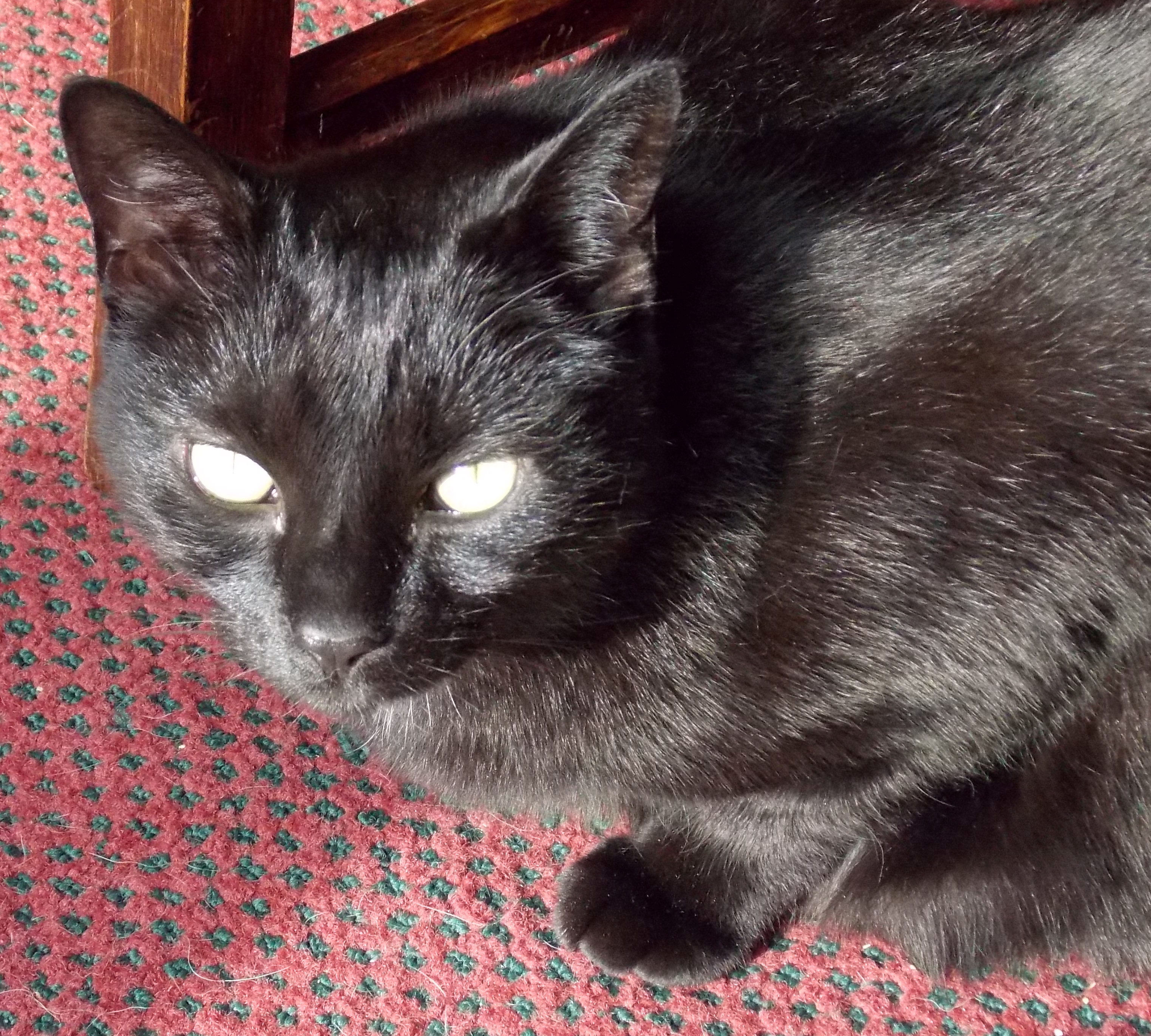
Soon I saw a long-haired black cat approaching the trap. Baited with fresh sardines, I knew that if she was hungry, she would go in. Sure enough, I was shortly rewarded with the distinctive clap of the metal door closing. I grabbed a large towel from my car, ran to the trap, and covered it with a towel because I know that the cat will be less panicky if she can’t see out of the trap. I took a brief peek at her, but she was balled up in the corner as fearful cats tend to do, so I really couldn’t see anything except that it was indeed a long-haired, black cat. I called her caregiver, who was on her way to the site to pick up the other one, a far less fearful short-haired black female. I headed home with the little black cat in the trap.

Shortly after my arrival, the caregiver arrived with the other less wild one in a carrier. We discussed next steps. She was against spaying them immediately; she wanted the cats to be able to have the kittens. Her husband was of the other, more practical, mind. As she is the caregiver, I did not want to do something against her wishes, and of course I was grappling with the reality of killing kittens in their mothers’ wombs anyway. We decided to give it a couple of days to think about what would be best. I put the cats in my “cat room” where they would be safe and where I could look after them well.

Over the course of the next few days, we talked regularly, the caregiver and I. On Sunday, she let me know that she thought it would be best to have the cats spayed immediately thereby ending the lives of the kittens. She had done some homework and found that this is the common solution when the shelters are full. I had expected that this could happen, so I had called on Friday and set an appointment for both of the cats for Monday morning with my vet.

On Monday evening I arrived at the office of my Belgian vet to pick up the cats and bring them home for their recovery. The veterinarian’s mother, who is her assistant, came out and said something in French that I asked her to repeat. “The longer haired one was not pregnant; she already has kittens somewhere. She had a litter of kittens five or more weeks ago.” The look on my face must have communicated volumes. “Mais oui,” she responded.

My heart dropped. 

A few minutes later the veterinarian emerged from the treatment area. “She had probably five or six kittens she said, at least five weeks ago. Maybe longer, but at a minimum five weeks,” she told me. “I can tell by the way her uterus has gone back into shape that it has to be at least five weeks.” By now I’m practically sobbing. “They can’t survive this long, can they?” I demanded. “It’s been since Thursday that she’s been away from them!”  The veterinarian grimaced. “If someone is feeding them, perhaps. But it has been quite cold.”

“By now they’re likely dead,” I admitted. The veterinarian’s facial expression told me she thought I was right. I rushed home, called the caregiver on the way (who was as devastated as I was), dropped the two cats off to my cat room for at least a day or two of recovery, and rushed back to the base where I spent the next hour and a half walking in the fine misty rain, near where I had trapped the momma cat. It was nearly dark, and the area is filled with possible hiding places. 

Shining my flashlight under the many small buildings, in the brush, amongst the new Spring growth in the light wooded areas, I searched, looking in vain for the glow of eyes or furtive movements. 

In the following days, I repeated the walk, drove around the area, asked for info on the local Facebook page, and banged on a door after hours so I could talk with the people inside the building who had placed a dish of cat food outside. No one has seen any kittens. Cats, yes. Kittens, no.

More than likely, with the cold, they got hungry, and when mama didn’t come back, they snuggled up in a pile and died of hypothermia. I didn’t know this for certain, but it was the most likely outcome. 

At the moment I was having a hard time forgiving myself. The poor mama cat must have been wondering what happened to her babies. Yes, I know animals mourn. I am sure she was mourning…her babies and her lost freedom.

The caregiver adopted the less wild one, Lily. I called the wilder one Mama Rose. She remained in the cat room for the next ten days so I could try to socialize her in the hope that she might be adoptable. Alas, it was not to be. She was too traumatized and frightened, so I released her where I’d caught her, where she’d be fed and have familiar places to hunker down in the weather. She regained her freedom, but she will never regain those babies.

And then, a few days later…
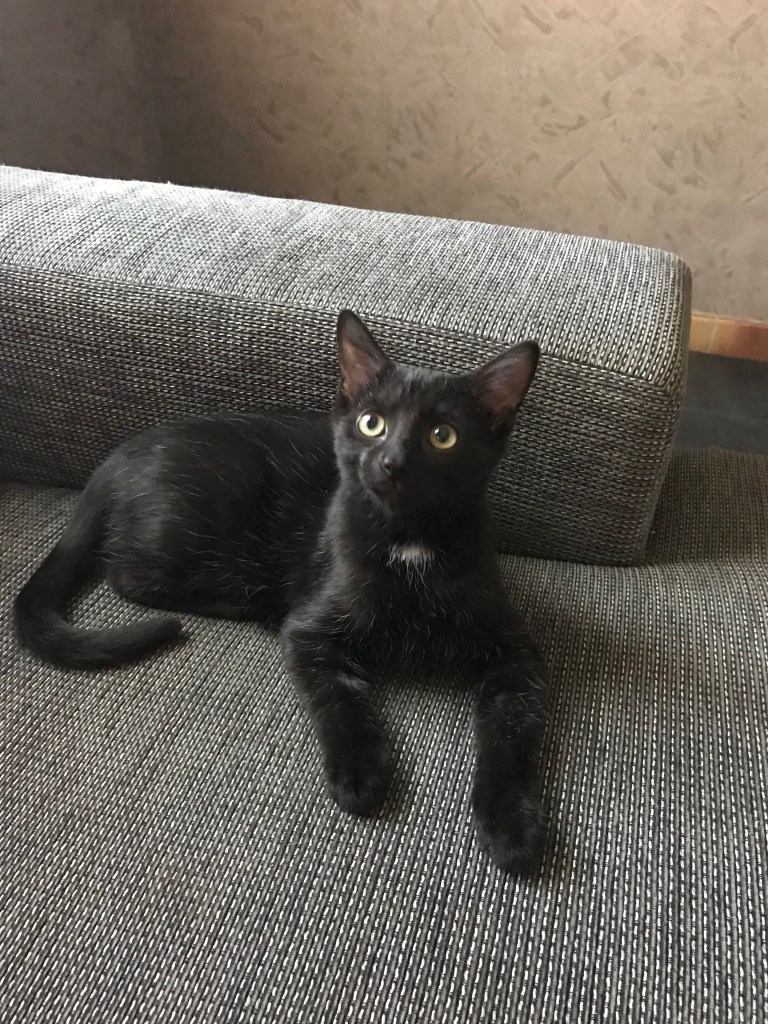
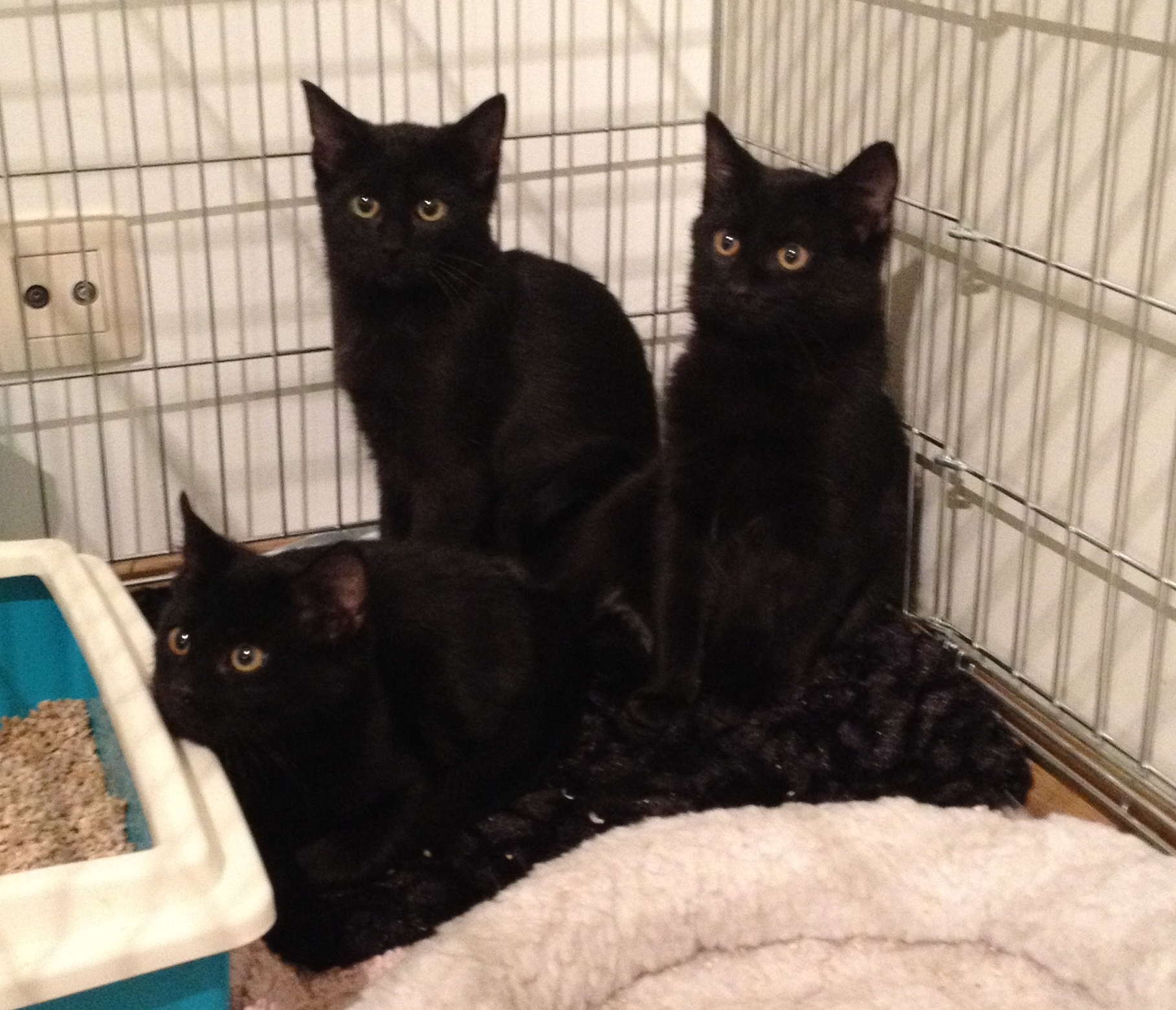
We found them. Five kittens, skittish and scared, brought out into the open by the presence of their mama. I got them trapped in short order. I brought them home, got furiously bitten by one of them, and cried with joy knowing they survived.

I got to work. They were so young, maybe six to seven weeks at the most. Only a little time hanging out with them and they were no longer afraid of me. Four boys and one shy little girl. One of the boys was smaller than the rest and sickly. But he was fearless. Every time he pooped all over himself and had to be cleaned up in the bathroom sink, he bounced right back. Many was the time he climbed up my pants leg in eager anticipation of dinner! He tried to sneak out the door of the room they were in, and he annoyed his siblings to no end.

Eventually, all the kittens were accepted in no-kill associations and adopted. All except the sickly one. He ended up with a wobble to his walk, perhaps the result of one of his fever episodes. I named him Liam. He is no longer little and sickly. He loves to eat and play and annoy his adopted feline siblings.

Sometimes doing good goes wrong, but things work out anyway.
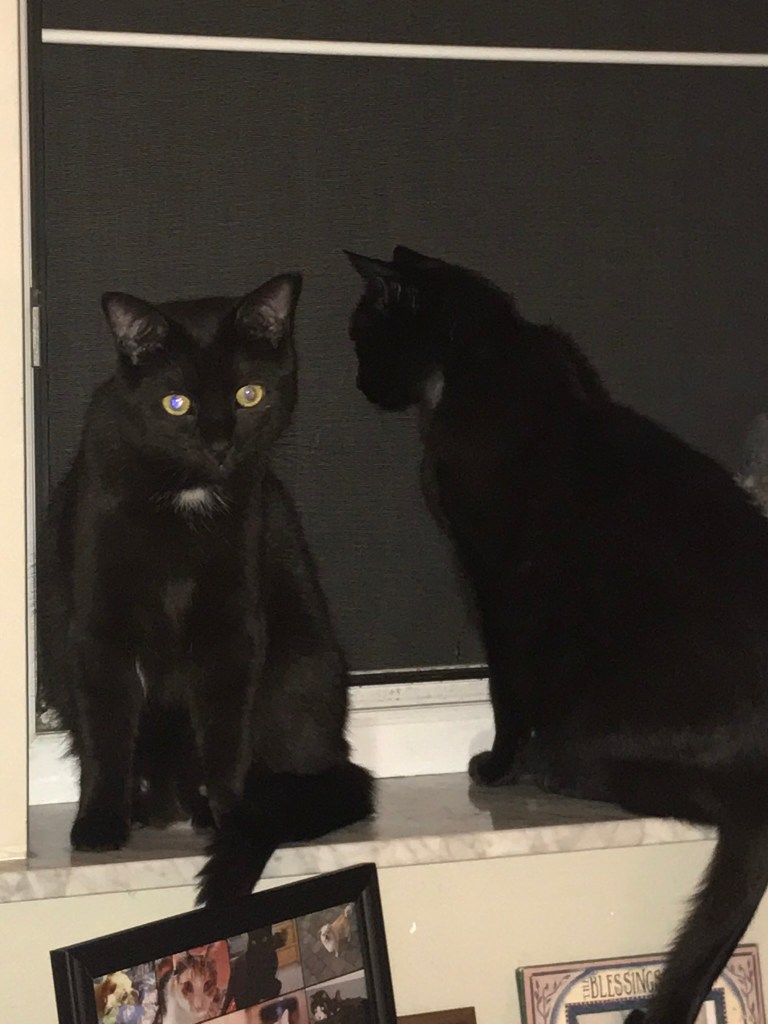
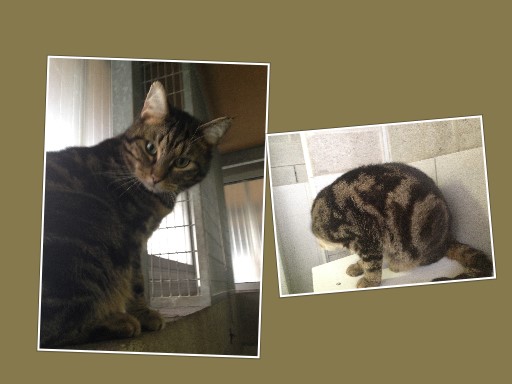
Liam facing the camera. That’s his older adopted brother George looking out the window.

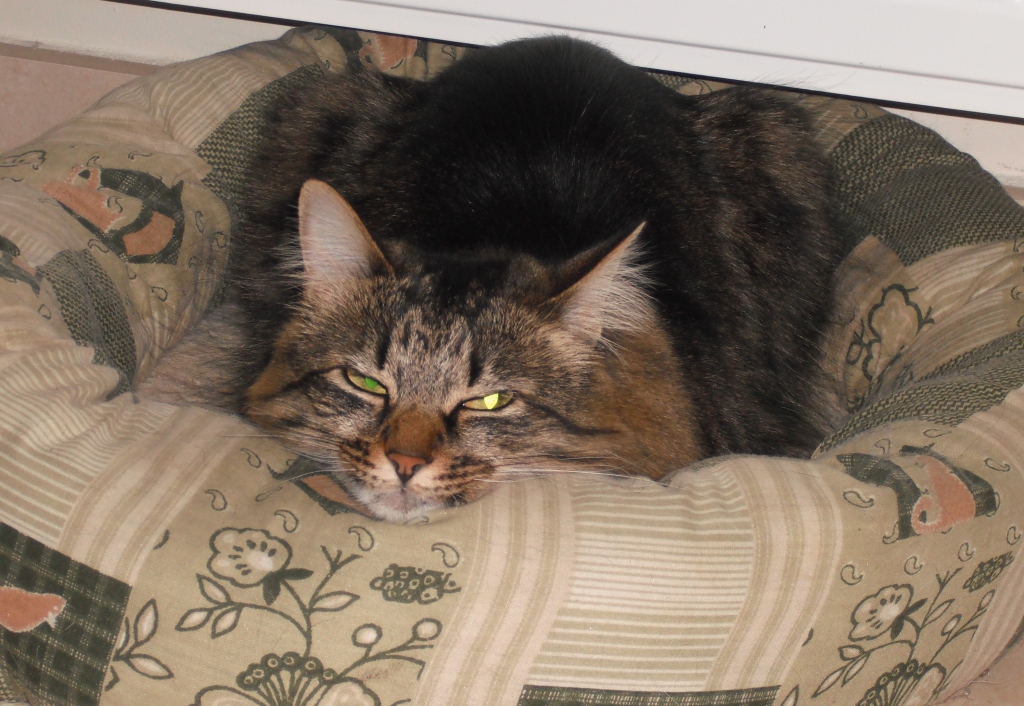
Update : this is a post written years ago but never published. It is time. Liam is now eight years old, and sweet George has crossed the Rainbow Bridge, and I am eager to see him again. Maggie and Gwen returned to the USA with me and Liam (pictured below in our new home) last summer.
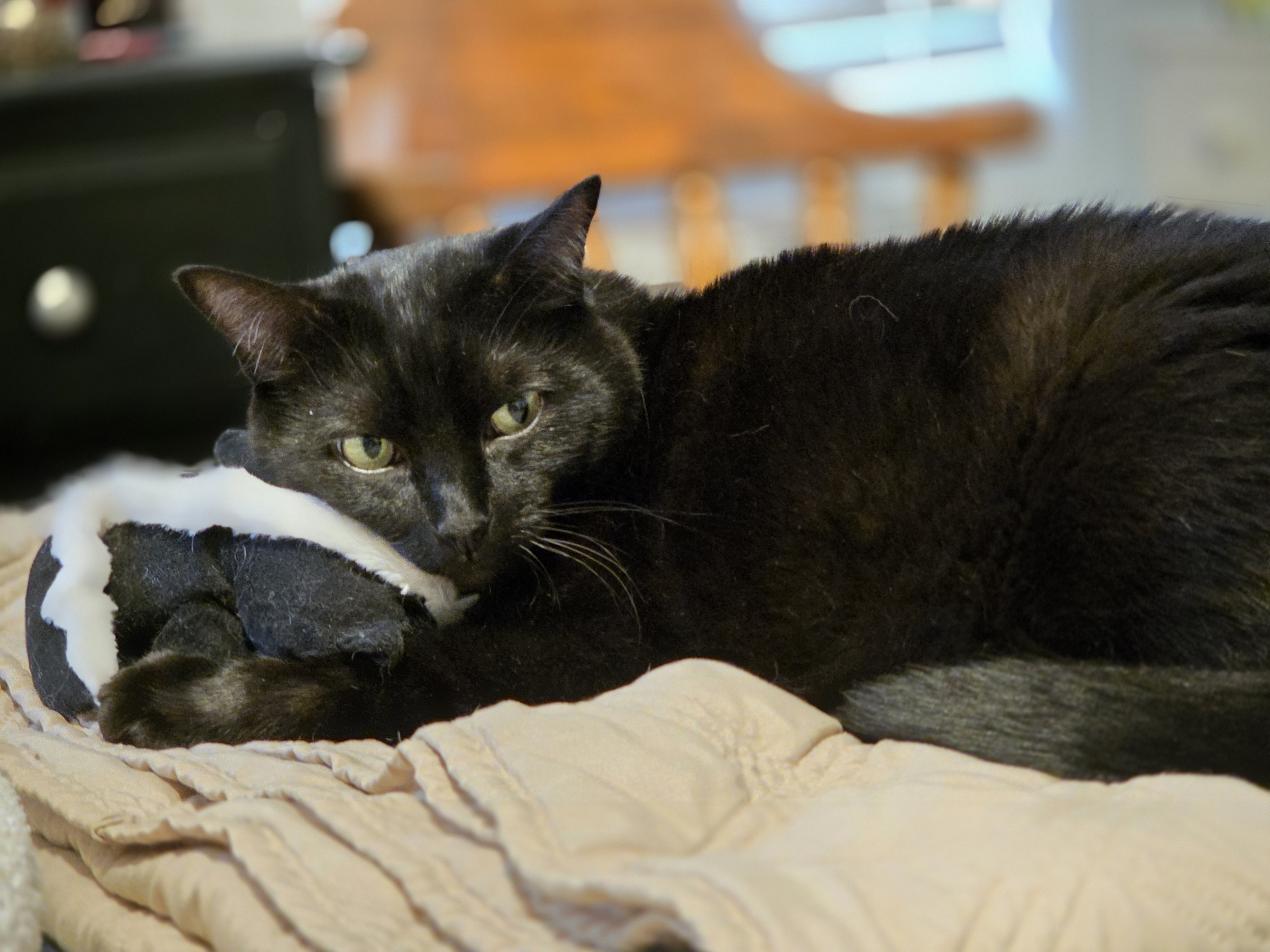
I am grateful for the happy ending.
More Waiting

This evening I tried again to trap one of the several black cats on the base. I was successful, although not the way I’d hoped.

First I trapped the same cat that I trapped a couple of weeks ago. I had her spayed the first time, of course, and didn’t need to trap her again. And despite her terror the first time she found herself with no way out, she went right in that trap again. “Not the sharpest knife in the drawer, are you?” I asked her. She didn’t respond. Too ashamed of her inability to resist tuna, I suppose.

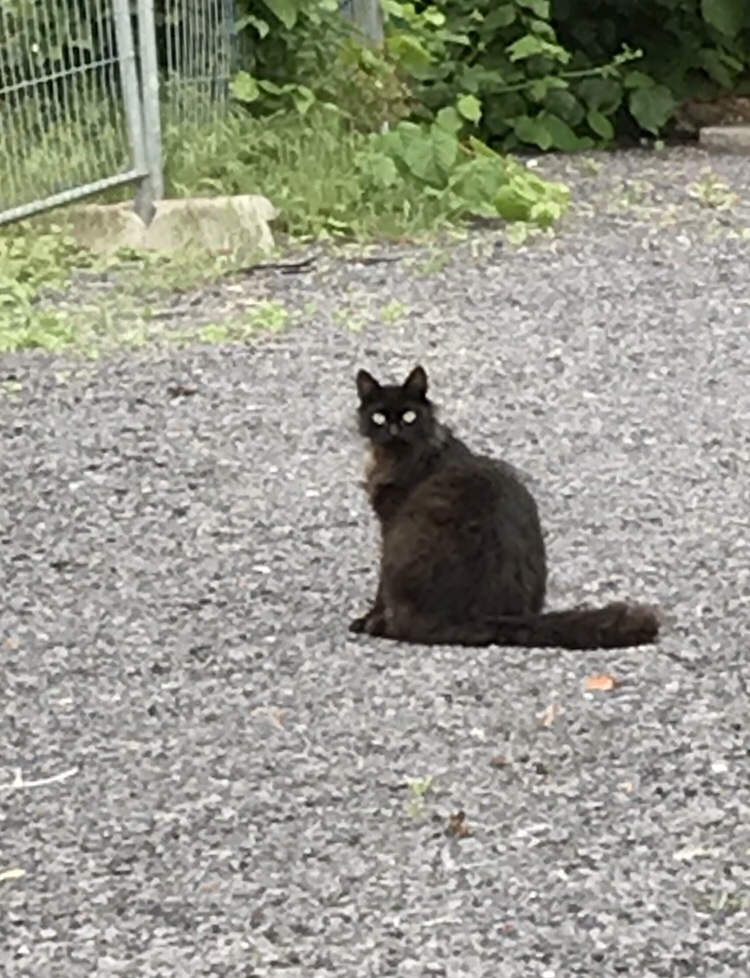
Next the elusive cat that I was trying to trap the last time I posted sauntered coolly into the trap, gobbled up the tuna, and exited without setting it off. Again. Which is all for the best, I suppose, as I am pretty sure she is no longer pregnant. Her nursing babies are going to need her for the next few weeks. I did finally get a good look at her and she is magnificent. Long charcoal fur with a full mane.

Finally the third and fourth cats appeared. One is clearly a Tom, with the telltale fat cheeks containing all those pheromones. The other is a fairly small, smooth coated, and of course, black cat. She couldn’t resist the tuna either, but she is not so wily as the other. As soon as the trap closed, I rushed her to the vet, and he helped me confirm what I suspected: she is nursing. I took her right back and released her.

It looks like in five or six weeks I will have at least two adult females, an adult male m, and who knows how many kittens to TNR or socialize. Until then, I leave them in peace. I, on the other hand, will be diligently seeking an elusive peace, knowing that all those little souls are struggling to stay alive in a hard world. Say a prayer.

Waiting

I’m sitting about 100 meters from a humane trap in which I’m hoping to catch what I’ve been told is a pregnant cat. I’m listening for that distinctive clap which tells me that the trap has sprung and the desired prey is safely inside. This is the fourth time I have set the trap for this particular cat. She’s quite wild, and she’s very clever. Perhaps she’s been listening to her pal tell her about when I trapped her and had her spayed a couple of weeks ago, a successful, although stressful TNR.

(TNR means Trap-Neuter-Release, the only option to successfully control a community cat population.)

Within the confines of the NATO base where I teach are a number of cats who don’t have family to go home to. Over the course of the last six years, on the campus of the school on base, and on the American base a few miles from here, some friends and I have trapped or otherwise assumed responsibility for upwards of 50 cats and kittens. The ones on the NATO base are primarily the cats abandoned by military members when they PCS, or are the offspring of those cats. Many of them, like the last five, have been kittens, which I and my compassionate cohorts have socialized and either found homes for or found no kill associations which found homes for them.

The adult cats have been much more difficult. Often they have become very distrustful of humans, and a few have been downright feral. The solution for those is very complicated. Some of them have been released in areas unfamiliar to them. I deeply resist that option because sometimes it turns out very badly. One such cat was kept in the ladies garage for several weeks, where the lady fed her, spoke softly to her, and even petted her some. In spite of this, when the cat was finally released, she ran off and was never seen again, breaking the hearts of her caregivers; I still worry about this cat sometimes. Obviously we don’t want that outcome. Ideally a cat who is truly wild, or who is so fearful of humans that they can’t let themselves be socialized, needs to be released where he was trapped. Luckily in this case there is a lady who has been feeding this small colony of cats and because of her, I was alerted and we are now trying to get this population of community cats TNR’d.

In spite of my repeated requests on social media for people to let me know when they’re getting ready to leave so that I can come by and get their cat or find a suitable home for it, folks continue to abandon their animals when they leave. Dogs get dumped at shelters, and cats simply get left behind. I always thought it was “those other countries ” who were doing such things, but I’ve come to learn that we Americans are just as guilty as everybody else.

Even after all these years associated with animal rescue, I still can’t understand how you can do that. How can you welcome an animal into your home without coming to love it? And how can you love anyone or anything and decide that they’re not worth taking with you when you go? Did you know that there are even people who abandon their animals when they go on vacation? They simply turn it out if it’s a cat, or if it’s a dog they tie it to a lamp post by the side of the road.

Before I became an animal rescuer I didn’t realize such things happened. I wouldn’t say that I was living in a state of complete ignorance; in fact I had spent many years weeping over articles that I read, statistics, and photographs. I belonged to the ASPCA, the Humane Society of the United States, and subscribed to vegetarian magazines. For a time I was a member of PETA until I realized that they too are simply an animal killing machine. But until I became an actual rescuer myself, I didn’t realize that our next-door neighbors and sometimes even our friends are not really animal lovers or even animal likers. Because if they were, these “good people” wouldn’t abandon their animals leaving, in the best possible situation, other people to pick up pieces.

So I’m sitting here waiting for that trap, praying that tonight will be the night that this female cat goes into it. Cross your fingers. Say a prayer.

An Update to Ferals and Fosters

About three years ago, I wrote a four-part series called Ferals and Fosters about three black kittens that a friend and I rescued. They marked the beginning of my journey in earnest as a hands-on fosterer and socializer of wild and semi-wild kittens and cats. I had been involved in rescue for years but had rarely really gotten my hands dirty. These three kittens showed me how great a difference one person can make. The final installment of that short series was about Sampson, a scared little black kitten who stole my heart as my first really difficult socialization success story.

When he was adopted, I cried like a little girl and I never stopped thinking of him. His new family rechristened him Sammy and sent me frequent updates about him via Facebook. Each new report made my heart sing; he was coming out of his shell and becoming a part of the family, even watching the husband play x-box and sleeping in bed with them and their other cat.

Last December I received a frantic message from Sammy’s adoptive human mom. They were returning to the US and during the pack-out with the movers, Sammy had somehow gotten out. Could I come help trap him?

I can only describe the next few days as panicked and tearful. I advised the family to put out his litter box and something with their scent on it. A small group of us searched day and night. We called. We sat and waited with smelly food. We put out the trap. We took canned mackerel and set it out all over the place. We put up posters and dropped flyers in every mailbox in the area. We created a Facebook group. As the days drew nearer for the family to get on the plane with their other two cats and their two children (both born since Sampson’s adoption, and one of the other two cats adopted since then), I became more and more depressed. Unfortunately, no one ever reported having seen him, and the family left as planned, but without Sammy.

A few of us kept looking for weeks. We set the trap in different places, hunted down potential leads (all dead ends and none of them actual sightings), and put out more flyers. We talked to people who lived in the area and contacted veterinarians. Absolutely zero. After several weeks with no sightings, nearly three months since he was lost, we had to admit we weren’t going to find him.

They lived near some busy roads, so he might have been hit by a car almost immediately. The family isn’t sure what time he got out so he could have been killed within minutes and picked up by city workers. Unfortunately, at that time, for reasons neither I nor his family understands, his microchip was not registered and so his body would have been unidentifiable. (When he was adopted, the chip was registered to me but when it was transferred to them, apparently it didn’t get re-registered. Lesson learned – double-check that your fur-babies’ chips are registered properly.)

He could also have been quickly adopted by another family who, for whatever reason, did not see our ads or flyers. This option is very unlikely because, as I found out from the adoptive mom, Sammy remained very cautious, somewhat fearful, and although he loved the two of them, he didn’t trust anyone else. My cautious, mistrusting little kitten had matured into a cautious, mistrusting little cat.

The third option, the most frightening one for me, is that he ran away and simply didn’t respond to any of our calls for him because he was either too scared or he simply didn’t want to come back home. Now my experience tells me that if he were too scared, he would have at least been spotted once or twice in the neighborhood, and as I said, we have no reports that he was. Further, within a few days, scared cats generally show back up. They gather their courage and return home.

I’m fairly certain, if Sammy was still alive at the time we were searching for him, he didn’t respond or return home because he didn’t WANT to come home. I know that sounds odd but I’ve thought a lot about this and talked about it with a couple of other folks, and we agree that it is certainly possible, and I think even likely.

You see, what had been, when he was adopted, a quiet and calm home with no kids and only one other cat became, within a year, a home with an infant and a third rescued cat (this one a life saved from the death list of a kill shelter). Shortly thereafter, another infant and now a toddler in the house. Finally there was the confusion and noise of not just one, but two household moves; only a few months before this one, they moved from the apartment to a house only a few doors down. Working for the government being what it is, their transfer to the US was a short-notice surprise. Add all of these elements together and you certainly have a situation that a mistrusting and fearful cat would seek to escape from.

Now, before all the potential judgement happens, when I adopted Sampson out, I made clear in the ads that he was fearful and needed lots of patience and a quiet home with NO KIDS. Further, I insisted upon that very firmly, in person, with the adopters. They assured me they had no plans to have children in the near future, and as I mentioned, in the first months after the adoption, Sammy made progress; he seemed to enjoy hanging out with the two of them. When the wife let me know, with some apparent trepidation, when they were pregnant, only a few months after the adoption, she assured me that it was a surprise. I trusted her as a long-time animal rescuer. In the best of situations, animal companions take a bit of a back seat when babies are born, and obviously the noise level grows as the household does. With all of this, and based on conversations with the parents since his disappearance, it seems that Sammy retreated some into his fearful shell, and this only further evidences that he wouldn’t want to come home.

Months later now, and I still cry for him sometimes. I pray for him often and think of him even more often. I punish myself with “what-if…’s” and “I should have…’s”. I hold out a tiny hope that perhaps, since he was micro-chipped (and now the chip is in my name again since his family is no longer in the country), he could still come home. But I have to admit, that hope is truly miniscule. And the thought that he is living the feral life somewhere terrifies me because I know how full of suffering – disease, hunger, predators, unmet needs – feral cats’ lives are.

I know that God hears me praying that if Sampson suffered, or suffers, that it is little or not at all, and that he either comes home to me or has a home where he is loved and feels safe. I suppose it is an unhappy testimony to how little I trust God that I continue to anguish sometimes about him. It pains me to admit that, but God knows how very human I am, and I trust He forgives me my frailties.

We foster families have many flaws, but we have one great strength which unfortunately is also a paradoxical weakness: love. We love each and every animal we take in, even if they stay with us for only a short time. For me, and I’m fairly confident this is true of all of us rescuers, there are three or four who are extra-special, whose effect on us is so profound that we are changed because of them. I loved Sampson; he taught me to never give up on a hard-case, that they could become the most loving of all. I never stopped thinking of him and I never stopped loving him, and if he one day manages to come back home, I will weep with joy.

The other installments:   Ferals and Fosters, Part Two
Ferals and Fosters, Part Three

Sampson15776986_10211422819956059_928528712484239052_o

So you want to help community cats?  Start here.

So you need to socialize some kittens? Click here.

Three Cat Night

Yesterday I went to Brussels and “adopted” three adult cats to foster. I intended to foster two but I ended up with three because eight was too many.

Ahem. Well.

There were two cats on short time in a shelter in Brussels. They are two of eight or so that were in the cattery there, all adult neutered males, and all have been there for over a year, some for two years. I went for Bambi and Toby because they have been there the longest, over a year each, and they are only a few weeks away from their time being up. When I arrived, I fell in love with Alban, Mingati, and a sad tuxedo cat. And I stood in the sterile, concrete cattery and tried my best not to cry. I was mostly successful. But only mostly.

I managed to get out of there with only three cats to foster, but with a heavy heart and a determination to find homes for as many of them as possible. For now, Benny (The Cat Formerly Known as Bambi), Toby and Alban are safe in my upstairs guest bedroom. They have a veterinarian appointment on Monday for a check up and then hopefully they will be ready to be adopted.

Mingati, the handsome tabby with Bengal markings, is on a short list as well, but I didn’t take him because there is a lady interested in him. He is on a 12-day quarantine to buy him some time. He is gorgeous.

Mingati

Mingati: his curious face and his stunning Bengal-like coat!

Although Mingati still has a lady interested in adopting him, he isn’t out of the woods yet. Until he is safely adopted, he is not out of the woods. In fact, as you might imagine, any animal in a shelter is at the mercy of the people who run the shelter. Sometimes decisions are made that are in the best interests of the animals, and sometimes decisions are made for expediency. That is why the No-Kill movement is so important, and why so many people are on board.

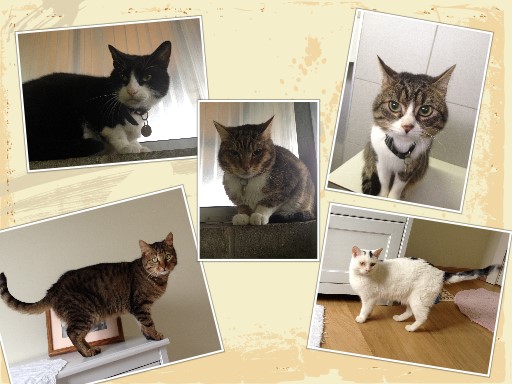
Alban in the middle, Toby bottom left and Benni bottom right. Top left and right are two who remain at the shelter.

Alban in the middle, Toby bottom left and Benny bottom right. Top left and right are two who remain at the shelter for now, but they are in my heart.

The tuxedo boy, top left, is very sad and shy, but he loves attention. Top right is a fat-cheeked small cat who loves rubs and snuggles. Not pictured are a small, inquisitive tabby, a bigger friendly tabby, two reverse tuxedo cats who love people, and I can’t remember if there are any others. All are sterilized males, and I think they are all two to four years old.

So for now, we think they are safe there, and Benny, Toby and Alban are here with me. But that isn’t the end. I’m not the end for these little ones. They need their forever homes. My own George, Gwen and Maggie are mine; they and my little dog love me and they need the majority of my attention and love. So these fosters and the ones left at the shelter must be adopted. You see, this is how no-kill works; people like me and you, we adopt these animals temporarily and work our butts off to find forever homes for them. We work really hard to find their homes because we have a vested interest; they are living in our homes. We have much greater motivation than shelter employees. It’s pretty simple, really, and it’s proven to work.

I love doing this because I know I’m making a difference. These cats deserve a chance and I’m helping to give it to them! It feels good for me, and at the end of the day, when they go to their forever homes, it will feel beyond good for me and for them. I can hardly wait.

Until then, I’m having three cat nights. Well, to put it precisely, they are six-cat-one-dog nights. And days.

But George isn’t going to put up with that for long!

George, my alpha cat.

George, my alpha cat.

So help George out and spread the word!

A footnote: be aware that when you look for no-kill information, you will find some naysayers. They are wrong. Keep digging before you make up your mind. 

Ferals and Fosters, Part Three

So here I am, a working woman on her own, and three kittens who were definitely acting out: pooping and worse — PEEING on the bed precisely where I would sit and speak sweetly to them, offering them treats and head scratches. *sigh* A few days, and a few loads of laundry later, and the mattress was UNDER the bed, safe below some thick plastic, and the kitties were easily prevented from hiding. UNDER! Whoever heard of a mattress UNDER a bed?

Whatever. Little by little, two of the three began coming out of their shells, letting me pet them, playing, being curious and mischievous, and generally loving life. Within perhaps three weeks, these two little darlings were not feral in the least. They were, in fact, at between four and five months old, ready to be sterilized and given their shots, and shortly thereafter, they were ready to be adopted!

Unfortunately, one of the kitties simply would not be domesticated. While he couldn’t hide, ‘Fraidy, as I had been calling him, effectively avoided me by running to the far side of the bed, and as it is a queen size bed, I couldn’t reach him. He would watch his siblings get scratches and loads of lovings, but he wanted none of it. The only time I could get to him was if he was in the kennel and I crawled in after him. Which I did for a week or so, then I gave him a week without doing that, and he became even more afraid. So I would crawl into the kennel and pick him up gently by the scruff and hold him for a few minutes. He was still fearful.

By now Christmas break was approaching and I had an airline ticket to the US for a week; I was worried. I didn’t know what I would do while I was gone, especially if brother and sister were adopted before then. I had to keep trying. I told my friend, the one who trapped them with me, that he needed a new name, one that wasn’t a self-fulfilling prophecy. “Oscar,” she suggested. “Gideon,” I replied.  Then I continued,  “Clint Eastwood, cuz he ain’t afraid of nothin’.” She responded, “Leo. Leo the Lion!” “Oh, that’s good!” I said, but before I could get used to it she said, “no, Sampson. Tough guy.” And so Sampson he became.

The other two kitties couldn’t get enough attention and I had a family ready to take both of  them within a week of posting the ad. They said they’d be ready to take them home within a couple of days. Sampson, on the other hand, continued to be afraid of everything remotely related to humans. He wouldn’t scratch me, though. He even stopped stiffening up when I reached into the kennel for him and pulled him out. And he’d be very quiet and docile while I held him and talked to him, scratching his little head. Sometimes he’d even purr a little. I remained hopeful.

The future family of the two tame kitties offered to take all three while I was out of town. I would take Sampson back as soon as I returned. So I held back tears as they drove away with all three kitties, and hoped for the best.

When I returned I contacted the adoptive family immediately via text. “I’ll be there to get Sampson this afternoon.” The wife said, “Okay…” then she continued, “We’re considering letting you take both the males home with you.” I was taken aback, but I would happily take them all back if it wasn’t working out. “What is going on?” I asked. She explained that the longer I was gone, the more anti-social ALL the kittens had become. The only one remotely friendly was the female, whom they’d named Pepper, and even she had reverted to some of her feral behaviors. I said, “You know I told you that if they don’t work out, they can come right back home with me; don’t fret. I’ll be there this afternoon and pick up any or all of them, whatever is best for you and the kitties.” And I headed upstairs to put fresh litter in the catbox and fresh water in the bowl.

I arrived to get Sampson, and I figured I’d probably be bringing Stormy, whose name references the wildly popular series, Dr. Who, home, too. Jay and Yvonne welcomed me in and we stood chatting for a few minutes. Finally, Yvonne looked at me and said, “We’ve decided we want to try to keep Pepper AND Stormy.” The couple exchanged a look. “We want to give them a week without Sampson.” I said, “Okay, that’s a great idea. It’s likely Sampson’s fear has had a negative effect on the other two.” They took me up to the room where the cats were staying, and only Pepper was visible. “Where are the boys?” I asked.

“I don’t know,” answered Jay. We looked around for them but only saw Pepper, sitting quietly atop a box. “Uh oh,” I thought, “they’ve managed to escape!”

To be continued…

Ferals and Fosters, Part Two

Yesterday, I posted about our base’s feral cat problem, and the three cats a couple of friends and I decided to rescue. Kittens, actually, about three months old. Feral kittens, to be precise. And they were coming home with me. Why me? Because I was the sucker of the three of us that was willing to spend the time trying to socialize them.

Now you should know, gentle reader, that I’m a terrible foster mom for cats. One of my cats, Maggie, is a failed foster. She came to me after having been found in a car engine as a tiny kitten. I tried to find a home for her but finally resigned myself to the fact that she would be mine. And she is; she loves me as much as any animal I’ve ever had, I think. I can’t imagine giving her up.

Maggie, my failed foster

Maggie, my failed foster

There were only two possible ends to this, neither of them good. One, with me as the crazy cat lady with six cats and no boyfriend (ever) or two, with me in tears watching my darling little furbabies ride away with their new family. Nevertheless, I brought the three little lovelies home.  I set up a borrowed extra-large kennel in a guest bedroom. I covered everything up, even putting a large shower curtain on the bed, under the fitted sheet, to prevent permanent damage from potential accidents. I blocked off ways to get under the bed because it is vital that kittens who need to be socialized not be able to hide from the human. My plan was to let the kitties out when they felt more comfortable, and to come in and sit with them often, letting them get used to me, begin to trust me, and eventually, hopefully become domesticated enough to be adopted.

The first night I left them free in the guest room while I slept down the hall, and all was well. They scampered into the kennel in the morning and I latched the door and went to work. That evening, I went and sat with them for an hour or so, working on my computer and talking to them softly. The following morning, there was a pile of cat poo in the middle of the bed. Well, no real damage done, I thought, and off I went to do laundry before work.

Three little fosters...

Three little fosters…

The next morning, same thing. And the next, the poo was surrounded by a veritable small pond of pee. And on top of that, they had managed to get under the bed. Well, then. An hour or so later, there was more laundry in the washer, the kittens were back in the kennel, and under the bed was once again blocked off.

The next morning, exactly the same scenario. Seriously? I mean, SERIOUSLY?

To say I was frustrated would be a vast understatement. I was seriously considering taking them back to the Kitty Kabana…

To be continued…

Ferals and Fosters, Part One

A few weeks ago, the military base where I work began talking about “getting rid of” the base’s feral cats. This particular military base is home to families from a lot of different countries, all either NATO or partner nations. Relatively few of the families are American; our presence is so numerous that we have to live off base. Which is fine with me; I love living out among the Belgians! But I digress.

Pet ownership is as popular in Europe as it is in the US, but the attitude regarding spaying and neutering is vastly different. While becoming more accepted, elective spay-neuter remains the exception. The prevalent paradigm in some countries is even that such surgery is cruel. This means, of course, that when families on the base where I work get a cat or a dog, there is a high likelihood that the animal will reproduce at some point in the near future. Add that to the fact that sometimes a family will PCS (Permanent Change of (duty) Station, i.e. “move”) and simply abandon their cat, and you have a recipe for exactly what has happened here on the base, and particularly near our ancient school buildings: cats give birth to kittens, kittens don’t have human contact, and POOF! Feral cats.

Our base’s history of feral cats is long and colorful. There is even a story of one falling through the drop ceilings and into a classroom! You can stop laughing now. Or go ahead and laugh; it is pretty funny, I admit. And several friends have adopted kittens that were born homeless to feral parents. When such kittens are adopted as soon as possible after they are born, they quickly socialize to humans. Such is exactly the case with my friend John and his best pal, Bruges.

John and Bruges right after he was adopted from the base

John and Bruges right after he was adopted from the base


So recently a few of us resident cat-lovers decided to do something about the problem. We began advocating for the cats, and two of us went so far as to trap three little black kittens living under the math building. Their mom had already moved on, and they were probably about eight or nine weeks old. They were easy to capture using a humane trap, and we took them to our colleague’s little shed beside her house; we call it the Kitty Kabana. For a couple of weeks, these fairly wild little creatures were doing fine: eating and protected from the elements. Unfortunately they were not becoming any less wild. After reading a couple of articles on taming the kittens, we realized they needed to be inside a home, getting used to having people around. Whose home? Ahem. Mine.

Want to find out what happens? Stay tuned…

Doing Good Across the Globe

Some people are drawn to causes that help children. Or maybe their passion is in finding a cure for cancer or Alzheimer’s. Others enjoy contributing to charities that fight poverty or hunger. Christians are called to help spread the Gospel, and many do that by supporting missionaries or local churches. I’m pretty fond of all these particular causes, myself. I’m a Christian with several friends fighting cancer, another whose mom (and the rest of her family) is dealing with Alzheimer’s. A lot of people I know contribute to World Vision or Compassion International (including me!), and most of my Christian friends give to their churches and to foreign missions. All important and good causes. My most important projects, however, are not always the most popular because the needs that speak to me most loudly are those of animals.

Right now one of my favorite causes is called Nowzad. Nowzad is an organization that rescues stray, abandoned or abused animals in Afghanistan, provides animal welfare education to the Afghan people, helps care for and humanely reduce the stray dog population, and helps soldiers rescue dogs and cats from the front lines and gets them the heck out of there, often sending them home (to the USA, UK, Canada, Italy, and other partner nations) to the families of soldiers serving in the line of fire. Lately I’ve been trying to help Lisa get out of the line of fire. She’s adorable, but so are all of them.

I’d invite you to take a look at some of what these good people are doing and support the cause, if you are so moved. These are good people doing good work in a dangerous and frightening place. I’m proud to help them do it!

Buddies

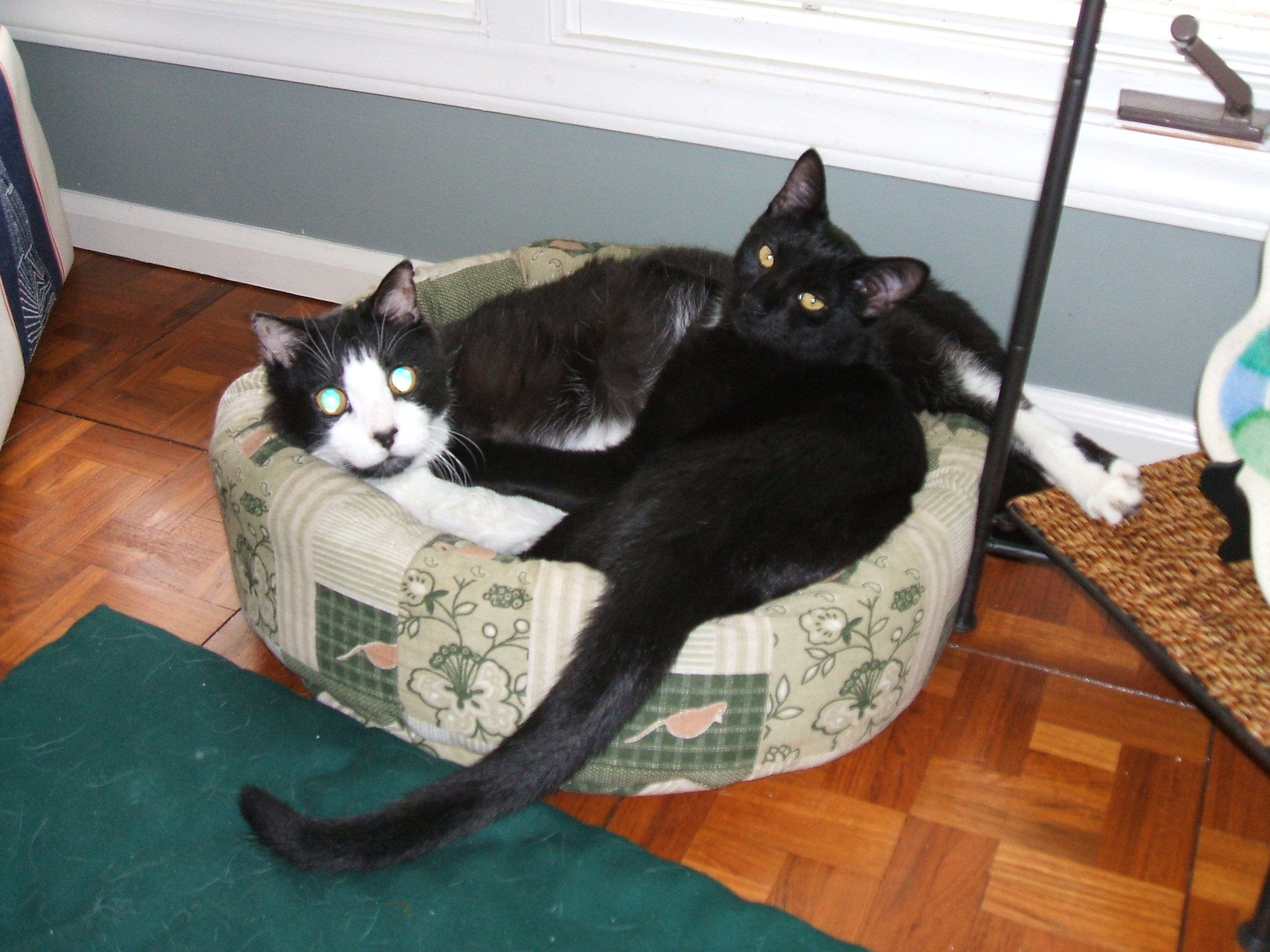
Two of my rescues: Hillcat, the tuxedo tripod who has already crossed the Rainbow Bridge, and George, my little black baby who continues to live with me here in Belgium. Each has his own story, but we’ll save those for another post.

And shortly I’ll be posting about just how important animal causes are to me…stay close!