When Doing Good Goes Wrong (in the short or long term)

I was just trying to do good. As I always do when I’m spaying or neutering a stray cat or a feral one. This time it didn’t go the way that I wanted it to. 

It was Spring, 2018. The lady who’d been feeding the cats on the base where I worked in the south of Belgium let me know that there were two pregnant females. The Société pour la Protection des Animaux and the private no-kill rescues were all overrun at the moment with cats and kittens. I knew that we had to get them and either spay them (aborting the babies) or let them have the kittens in security and safety and keep them from being wild, or at least help them to not be too frightened to be adoptable. 

This was already about to be a nightmare for me, as I pride myself on what I call my consistent life ethic. I am vegetarian, anti-death penalty, anti-zoo, anti-vivisection, pro-immigration, and anti-abortion. And as to the latter, I’m not what’s come to be known as an anti-birther; I want to take care of babies that are born, somehow, and well. So knowing that on the table was the distinct possibility of aborting kittens was already tearing at me.

On Thursday evening I arrived at the site before their caregiver. A couple of days before, she had told me where the more fearful one would appear, and I set the humane trap there. I withdrew from the area and sat in my car about 100 meters away from the trap; this was a cat who didn’t come very close to her caregiver. I could just see the trap, as it was dusk and pretty far.

Soon I saw a long-haired black cat approaching the trap. Baited with fresh sardines, I knew that if she was hungry, she would go in. Sure enough, I was shortly rewarded with the distinctive clap of the metal door closing. I grabbed a large towel from my car, ran to the trap, and covered it with a towel because I know that the cat will be less panicky if she can’t see out of the trap. I took a brief peek at her, but she was balled up in the corner as fearful cats tend to do, so I really couldn’t see anything except that it was indeed a long-haired, black cat. I called her caregiver, who was on her way to the site to pick up the other one, a far less fearful short-haired black female. I headed home with the little black cat in the trap.

Shortly after my arrival, the caregiver arrived with the other less wild one in a carrier. We discussed next steps. She was against spaying them immediately; she wanted the cats to be able to have the kittens. Her husband was of the other, more practical, mind. As she is the caregiver, I did not want to do something against her wishes, and of course I was grappling with the reality of killing kittens in their mothers’ wombs anyway. We decided to give it a couple of days to think about what would be best. I put the cats in my “cat room” where they would be safe and where I could look after them well.

Over the course of the next few days, we talked regularly, the caregiver and I. On Sunday, she let me know that she thought it would be best to have the cats spayed immediately thereby ending the lives of the kittens. She had done some homework and found that this is the common solution when the shelters are full. I had expected that this could happen, so I had called on Friday and set an appointment for both of the cats for Monday morning with my vet.

On Monday evening I arrived at the office of my Belgian vet to pick up the cats and bring them home for their recovery. The veterinarian’s mother, who is her assistant, came out and said something in French that I asked her to repeat. “The longer haired one was not pregnant; she already has kittens somewhere. She had a litter of kittens five or more weeks ago.” The look on my face must have communicated volumes. “Mais oui,” she responded.

My heart dropped. 

A few minutes later the veterinarian emerged from the treatment area. “She had probably five or six kittens she said, at least five weeks ago. Maybe longer, but at a minimum five weeks,” she told me. “I can tell by the way her uterus has gone back into shape that it has to be at least five weeks.” By now I’m practically sobbing. “They can’t survive this long, can they?” I demanded. “It’s been since Thursday that she’s been away from them!”  The veterinarian grimaced. “If someone is feeding them, perhaps. But it has been quite cold.”

“By now they’re likely dead,” I admitted. The veterinarian’s facial expression told me she thought I was right. I rushed home, called the caregiver on the way (who was as devastated as I was), dropped the two cats off to my cat room for at least a day or two of recovery, and rushed back to the base where I spent the next hour and a half walking in the fine misty rain, near where I had trapped the momma cat. It was nearly dark, and the area is filled with possible hiding places. 

Shining my flashlight under the many small buildings, in the brush, amongst the new Spring growth in the light wooded areas, I searched, looking in vain for the glow of eyes or furtive movements. 

In the following days, I repeated the walk, drove around the area, asked for info on the local Facebook page, and banged on a door after hours so I could talk with the people inside the building who had placed a dish of cat food outside. No one has seen any kittens. Cats, yes. Kittens, no.

More than likely, with the cold, they got hungry, and when mama didn’t come back, they snuggled up in a pile and died of hypothermia. I didn’t know this for certain, but it was the most likely outcome. 

At the moment I was having a hard time forgiving myself. The poor mama cat must have been wondering what happened to her babies. Yes, I know animals mourn. I am sure she was mourning…her babies and her lost freedom.

The caregiver adopted the less wild one, Lily. I called the wilder one Mama Rose. She remained in the cat room for the next ten days so I could try to socialize her in the hope that she might be adoptable. Alas, it was not to be. She was too traumatized and frightened, so I released her where I’d caught her, where she’d be fed and have familiar places to hunker down in the weather. She regained her freedom, but she will never regain those babies.

And then, a few days later…
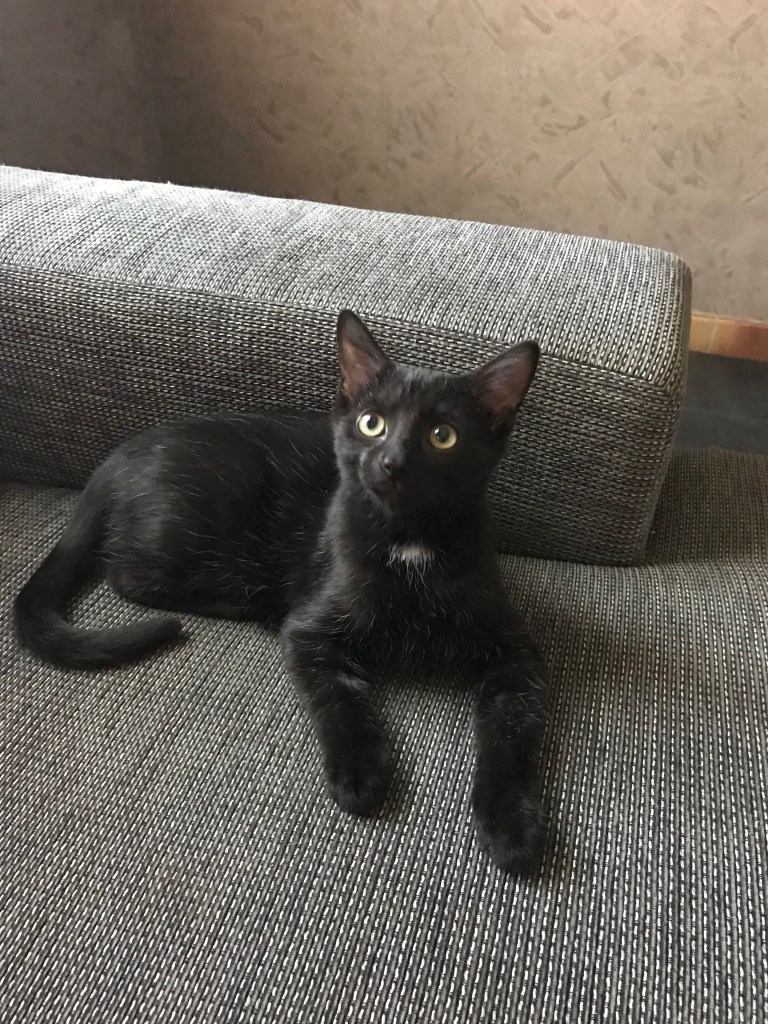
We found them. Five kittens, skittish and scared, brought out into the open by the presence of their mama. I got them trapped in short order. I brought them home, got furiously bitten by one of them, and cried with joy knowing they survived.

I got to work. They were so young, maybe six to seven weeks at the most. Only a little time hanging out with them and they were no longer afraid of me. Four boys and one shy little girl. One of the boys was smaller than the rest and sickly. But he was fearless. Every time he pooped all over himself and had to be cleaned up in the bathroom sink, he bounced right back. Many was the time he climbed up my pants leg in eager anticipation of dinner! He tried to sneak out the door of the room they were in, and he annoyed his siblings to no end.

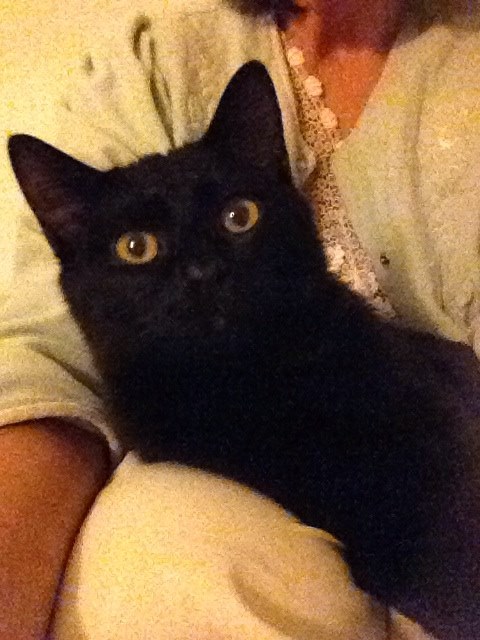
Eventually, all the kittens were accepted in no-kill associations and adopted. All except the sickly one. He ended up with a wobble to his walk, perhaps the result of one of his fever episodes. I named him Liam. He is no longer little and sickly. He loves to eat and play and annoy his adopted feline siblings.

Sometimes doing good goes wrong, but things work out anyway.
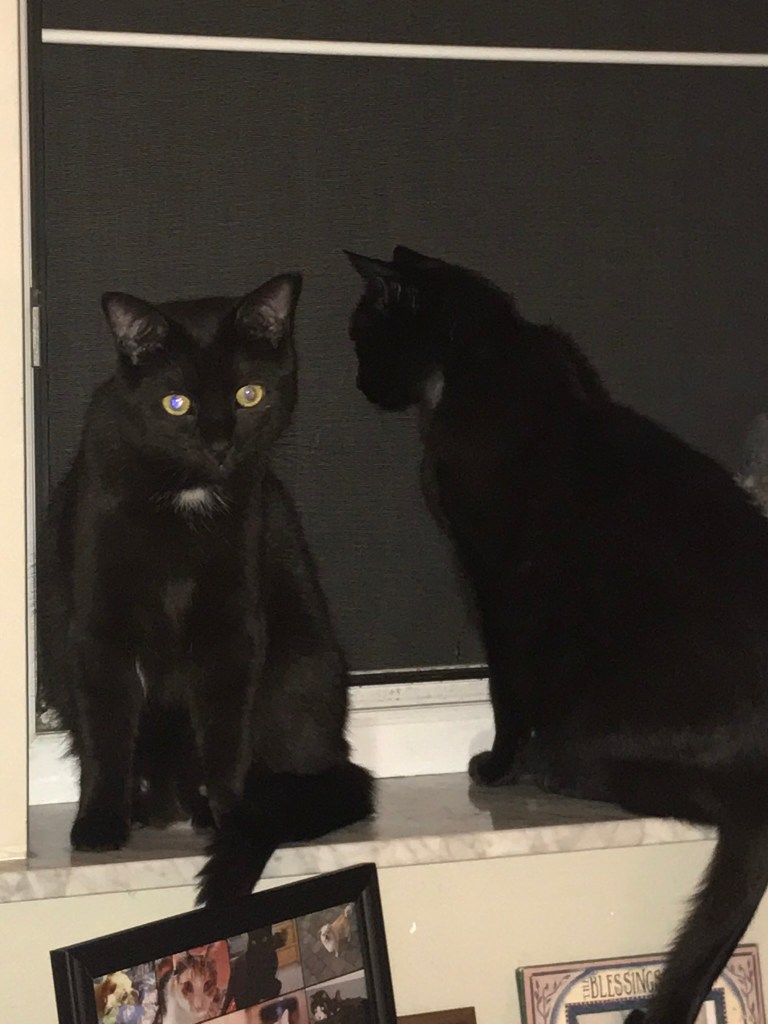
Liam facing the camera. That’s his older adopted brother George looking out the window.

Update : this is a post written years ago but never published. It is time. Liam is now eight years old, and sweet George has crossed the Rainbow Bridge, and I am eager to see him again. Maggie and Gwen returned to the USA with me and Liam (pictured below in our new home) last summer.
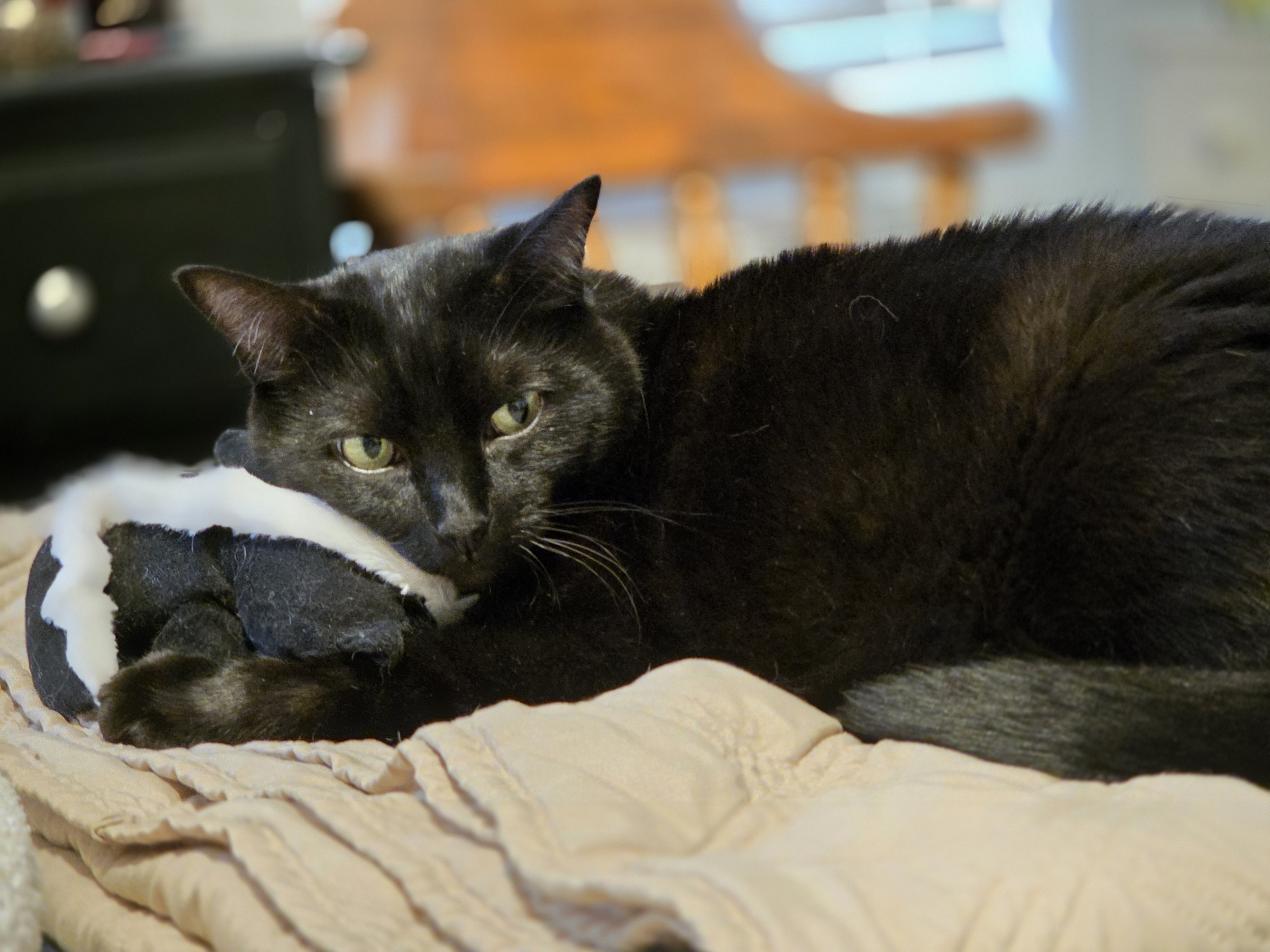
I am grateful for the happy ending.
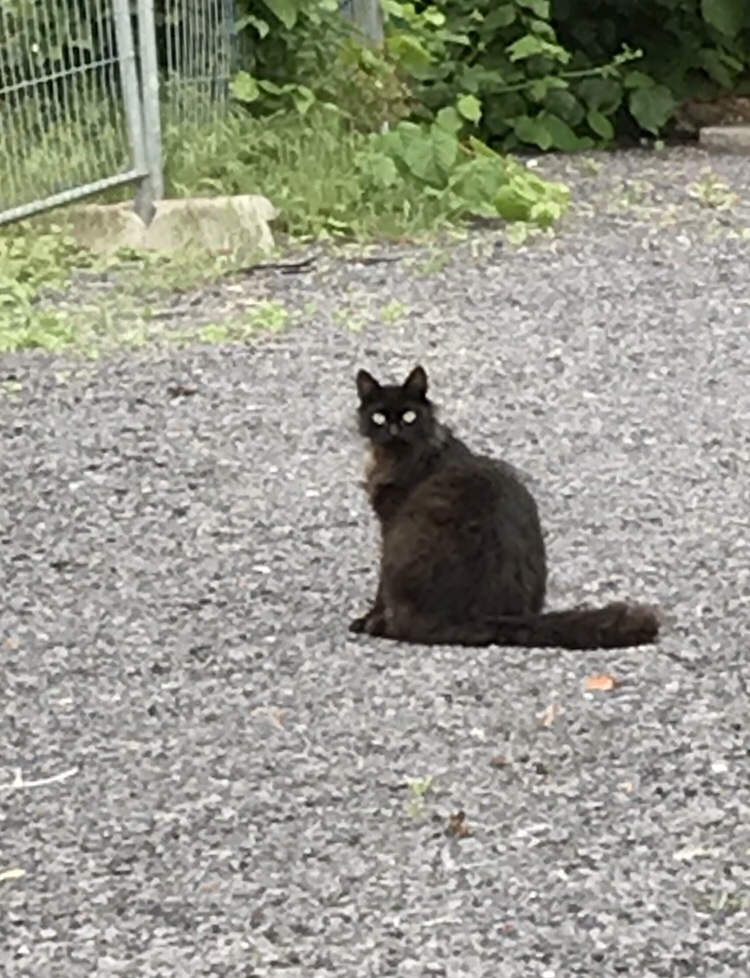
More Waiting

This evening I tried again to trap one of the several black cats on the base. I was successful, although not the way I’d hoped.

First I trapped the same cat that I trapped a couple of weeks ago. I had her spayed the first time, of course, and didn’t need to trap her again. And despite her terror the first time she found herself with no way out, she went right in that trap again. “Not the sharpest knife in the drawer, are you?” I asked her. She didn’t respond. Too ashamed of her inability to resist tuna, I suppose.

Next the elusive cat that I was trying to trap the last time I posted sauntered coolly into the trap, gobbled up the tuna, and exited without setting it off. Again. Which is all for the best, I suppose, as I am pretty sure she is no longer pregnant. Her nursing babies are going to need her for the next few weeks. I did finally get a good look at her and she is magnificent. Long charcoal fur with a full mane.

Finally the third and fourth cats appeared. One is clearly a Tom, with the telltale fat cheeks containing all those pheromones. The other is a fairly small, smooth coated, and of course, black cat. She couldn’t resist the tuna either, but she is not so wily as the other. As soon as the trap closed, I rushed her to the vet, and he helped me confirm what I suspected: she is nursing. I took her right back and released her.

It looks like in five or six weeks I will have at least two adult females, an adult male m, and who knows how many kittens to TNR or socialize. Until then, I leave them in peace. I, on the other hand, will be diligently seeking an elusive peace, knowing that all those little souls are struggling to stay alive in a hard world. Say a prayer.

Waiting

I’m sitting about 100 meters from a humane trap in which I’m hoping to catch what I’ve been told is a pregnant cat. I’m listening for that distinctive clap which tells me that the trap has sprung and the desired prey is safely inside. This is the fourth time I have set the trap for this particular cat. She’s quite wild, and she’s very clever. Perhaps she’s been listening to her pal tell her about when I trapped her and had her spayed a couple of weeks ago, a successful, although stressful TNR.

(TNR means Trap-Neuter-Release, the only option to successfully control a community cat population.)

Within the confines of the NATO base where I teach are a number of cats who don’t have family to go home to. Over the course of the last six years, on the campus of the school on base, and on the American base a few miles from here, some friends and I have trapped or otherwise assumed responsibility for upwards of 50 cats and kittens. The ones on the NATO base are primarily the cats abandoned by military members when they PCS, or are the offspring of those cats. Many of them, like the last five, have been kittens, which I and my compassionate cohorts have socialized and either found homes for or found no kill associations which found homes for them.

The adult cats have been much more difficult. Often they have become very distrustful of humans, and a few have been downright feral. The solution for those is very complicated. Some of them have been released in areas unfamiliar to them. I deeply resist that option because sometimes it turns out very badly. One such cat was kept in the ladies garage for several weeks, where the lady fed her, spoke softly to her, and even petted her some. In spite of this, when the cat was finally released, she ran off and was never seen again, breaking the hearts of her caregivers; I still worry about this cat sometimes. Obviously we don’t want that outcome. Ideally a cat who is truly wild, or who is so fearful of humans that they can’t let themselves be socialized, needs to be released where he was trapped. Luckily in this case there is a lady who has been feeding this small colony of cats and because of her, I was alerted and we are now trying to get this population of community cats TNR’d.

In spite of my repeated requests on social media for people to let me know when they’re getting ready to leave so that I can come by and get their cat or find a suitable home for it, folks continue to abandon their animals when they leave. Dogs get dumped at shelters, and cats simply get left behind. I always thought it was “those other countries ” who were doing such things, but I’ve come to learn that we Americans are just as guilty as everybody else.

Even after all these years associated with animal rescue, I still can’t understand how you can do that. How can you welcome an animal into your home without coming to love it? And how can you love anyone or anything and decide that they’re not worth taking with you when you go? Did you know that there are even people who abandon their animals when they go on vacation? They simply turn it out if it’s a cat, or if it’s a dog they tie it to a lamp post by the side of the road.

Before I became an animal rescuer I didn’t realize such things happened. I wouldn’t say that I was living in a state of complete ignorance; in fact I had spent many years weeping over articles that I read, statistics, and photographs. I belonged to the ASPCA, the Humane Society of the United States, and subscribed to vegetarian magazines. For a time I was a member of PETA until I realized that they too are simply an animal killing machine. But until I became an actual rescuer myself, I didn’t realize that our next-door neighbors and sometimes even our friends are not really animal lovers or even animal likers. Because if they were, these “good people” wouldn’t abandon their animals leaving, in the best possible situation, other people to pick up pieces.

So I’m sitting here waiting for that trap, praying that tonight will be the night that this female cat goes into it. Cross your fingers. Say a prayer.

Final Installment in: Ferals and Fosters

“Where are the boys?” I asked, when I could only see Pepper sitting on top of a box.

“I don’t know,” answered Jay. We started searching the room, and Jay noticed a hole in a box underneath another box. We moved the box on top and opened the other one, and there were Sampson and Stormy, snuggled up together. “Oh, dear,” I said, as Jay picked Stormy up. I gathered Sampson up and he stiffened but didn’t resist. I put him in the carrier and zipped it up. I wished them luck and headed home with my little ‘fraidy cat.

Sampson remained in his little circle bed inside the wire kennel for the first half day. Then he ventured out to eat. Later that evening, to my surprise, I heard him meowing. I had never heard him vocalize at all before! I went up and walked into the room. For the first time in his little life, he didn’t run from a human. In fact, he didn’t seem at all afraid. He was cautious, and he was curious. And lonely. This was the first time in his short, four or five months of life that he’d ever been alone. He finally didn’t have his brother and sister to lean on, and he didn’t like it. He didn’t want to be held but he sure wanted me near. So much so, in fact, that he actually approached me! This, too, was a first. Now he wanted me around, let me pick him up without fear, and snuggled up as I petted him. I hung out with him for a while and he finally began to play with me as I dangled a feather that was attached to a plastic stick.

That evening, when I went to bed, I heard him meowing again, all alone in his room. He was very insistent and loud. I hardened my heart, knowing I mustn’t teach him that meowing loudly was the way to get his needs met. Soon it became quiet.

By the next afternoon, Sampson was a different cat.  He wanted to be held and touched; he meowed for attention, and snuggled up against me when I held him. He called for me when I wasn’t in the room with him, and he wanted to come out and be with me and the other cats, which I tried to do, but he was overwhelmed by them, and they were afraid of him (as I expected) so I continued to keep them separate. He loved my company, though, and he wanted to play and be touched all the time. He became such a little lover-boy that I neglected my own furbabies a little so I could be with him over the next days. I was quickly falling in love with this little guy.

On my lap: finally comfortable with human contact.

On my lap: finally comfortable with human contact.

Well, I knew I was in danger of ending up with FOUR cats instead of the three I had, so I put an ad on our local community’s facebook page. Within two days, a lady contacted me and asked about him. They had recently lost their beloved black cat and their other cat was lonely; they wanted to have a companion for her, as well as for them. We talked for a few days then arranged for her and her husband to come and meet him.

They arrived earlier than planned, but no matter. I brought Sampson down to see them and he stiffened up immediately, as I was sure he would. The wife and I chatted and then I held him out to her and said, “Would you like to hold him?” and she eagerly took him from me. He was clearly uncomfortable but he watched me for clues. When he saw I was calm, he consented and finally relaxed a little. She unhesitatingly fell under his spell and it was clear she wanted him. The husband watched Sampson, whose fear was unmistakable. “Do you think he’ll relax with us and our other cat?” he asked me. I could only be truthful. “I don’t really know,” I said, “I would expect he will, but it might take time. And if it doesn’t look like it’s going to work out for any reason, just let me know and I’ll take him back.” They exchanged a look and she said, “We want him.” So I gathered his belongings and bit back tears, and I let them take my little sweetheart out the door. And then I cried like a child.

Over the course of the next few days, I learned that the other two kitties were doing great. Without Sampson’s negative influence, they were coming out and socializing with the family, finding favorite hangouts in the house, and generally becoming normal house cats. And Sampson? Well, he quickly adjusted to his new home and family, even snuggling under the covers with them at night! My darling little fellow loves to watch his new daddy play xBox and climb the enormous cat tree they have. And sleep in his new mommy’s arms. Getting updates from both the adoptive families makes me indescribably happy.

I have discovered that I’ve never done anything as rewarding as this. As much trouble as they were, as many loads of laundry and and as much money as I spent, the happiness I feel knowing they are loved and learning to love is beyond mere words. I possess a very clear understanding of  how much BETTER their lives are now than if I’d not gotten involved. If my friend and I had not let our feelings turn into action, these little guys would be cold, hungry and afraid. And the little girl would undoubtedly be pregnant by now, about to give birth to more hungry, cold, frightened kittens. We stopped that cycle, at least for them.

Let’s not let ourselves think that we can do nothing, or that we can’t do enough. Every time we say, “the problem is too great,” or “I can’t handle the pain,” remember the difference two women made in the lives of three feral kittens. This won’t be the last time I cry for the voiceless ones, and it won’t be the last time I act on their behalf. And I’m sure it won’t be the last time I fall in love with a formerly feral foster feline!

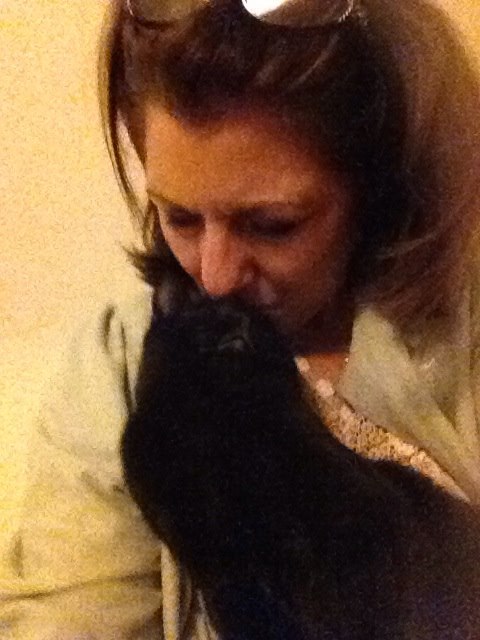
Reaching up for a kiss on the head

Reaching up for a kiss on the head

Ferals and Fosters, Part Two

Yesterday, I posted about our base’s feral cat problem, and the three cats a couple of friends and I decided to rescue. Kittens, actually, about three months old. Feral kittens, to be precise. And they were coming home with me. Why me? Because I was the sucker of the three of us that was willing to spend the time trying to socialize them.

Now you should know, gentle reader, that I’m a terrible foster mom for cats. One of my cats, Maggie, is a failed foster. She came to me after having been found in a car engine as a tiny kitten. I tried to find a home for her but finally resigned myself to the fact that she would be mine. And she is; she loves me as much as any animal I’ve ever had, I think. I can’t imagine giving her up.

Maggie, my failed foster

Maggie, my failed foster

There were only two possible ends to this, neither of them good. One, with me as the crazy cat lady with six cats and no boyfriend (ever) or two, with me in tears watching my darling little furbabies ride away with their new family. Nevertheless, I brought the three little lovelies home.  I set up a borrowed extra-large kennel in a guest bedroom. I covered everything up, even putting a large shower curtain on the bed, under the fitted sheet, to prevent permanent damage from potential accidents. I blocked off ways to get under the bed because it is vital that kittens who need to be socialized not be able to hide from the human. My plan was to let the kitties out when they felt more comfortable, and to come in and sit with them often, letting them get used to me, begin to trust me, and eventually, hopefully become domesticated enough to be adopted.

The first night I left them free in the guest room while I slept down the hall, and all was well. They scampered into the kennel in the morning and I latched the door and went to work. That evening, I went and sat with them for an hour or so, working on my computer and talking to them softly. The following morning, there was a pile of cat poo in the middle of the bed. Well, no real damage done, I thought, and off I went to do laundry before work.

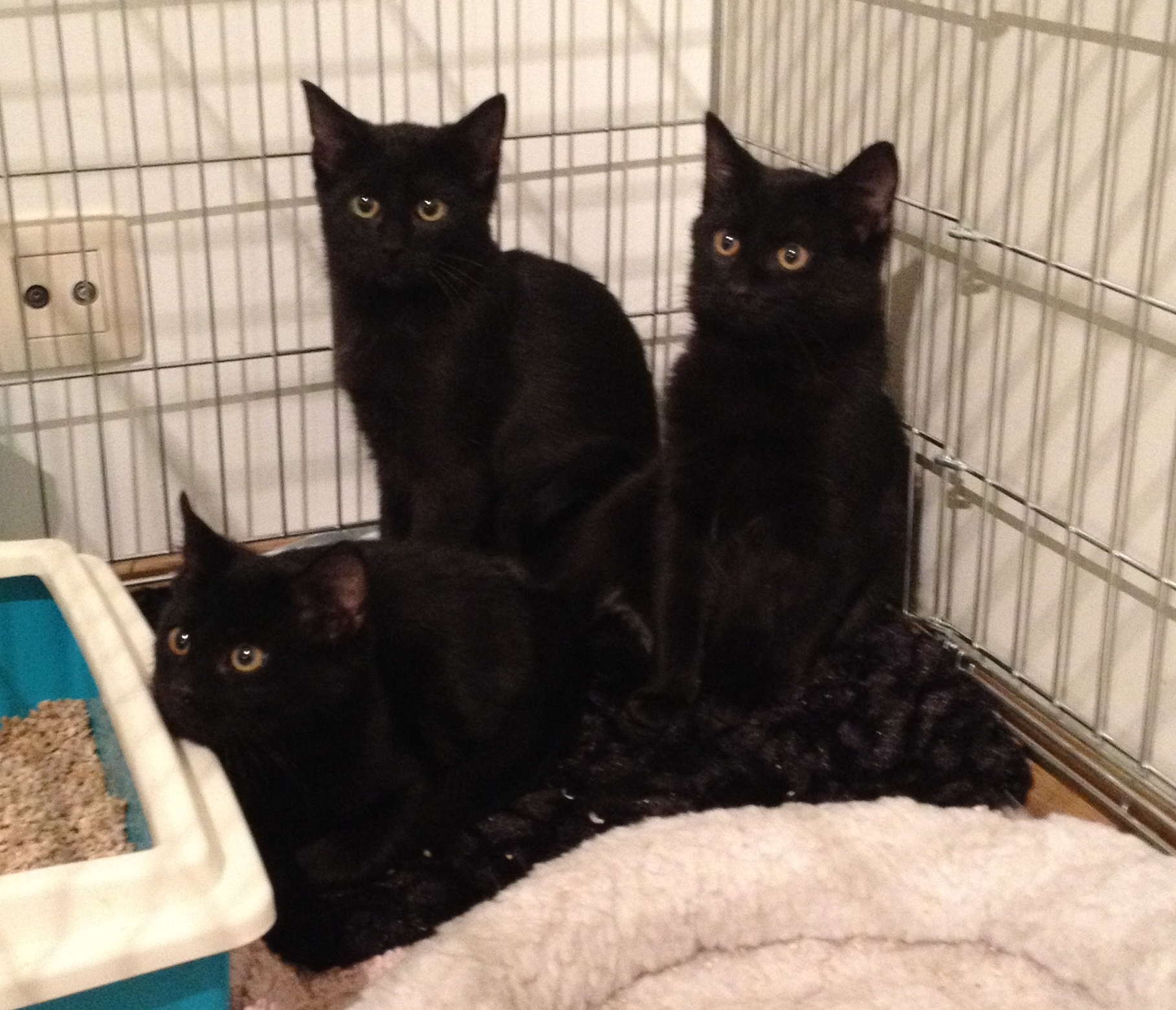
Three little fosters...

Three little fosters…

The next morning, same thing. And the next, the poo was surrounded by a veritable small pond of pee. And on top of that, they had managed to get under the bed. Well, then. An hour or so later, there was more laundry in the washer, the kittens were back in the kennel, and under the bed was once again blocked off.

The next morning, exactly the same scenario. Seriously? I mean, SERIOUSLY?

To say I was frustrated would be a vast understatement. I was seriously considering taking them back to the Kitty Kabana…

To be continued…

Ferals and Fosters, Part One

A few weeks ago, the military base where I work began talking about “getting rid of” the base’s feral cats. This particular military base is home to families from a lot of different countries, all either NATO or partner nations. Relatively few of the families are American; our presence is so numerous that we have to live off base. Which is fine with me; I love living out among the Belgians! But I digress.

Pet ownership is as popular in Europe as it is in the US, but the attitude regarding spaying and neutering is vastly different. While becoming more accepted, elective spay-neuter remains the exception. The prevalent paradigm in some countries is even that such surgery is cruel. This means, of course, that when families on the base where I work get a cat or a dog, there is a high likelihood that the animal will reproduce at some point in the near future. Add that to the fact that sometimes a family will PCS (Permanent Change of (duty) Station, i.e. “move”) and simply abandon their cat, and you have a recipe for exactly what has happened here on the base, and particularly near our ancient school buildings: cats give birth to kittens, kittens don’t have human contact, and POOF! Feral cats.

Our base’s history of feral cats is long and colorful. There is even a story of one falling through the drop ceilings and into a classroom! You can stop laughing now. Or go ahead and laugh; it is pretty funny, I admit. And several friends have adopted kittens that were born homeless to feral parents. When such kittens are adopted as soon as possible after they are born, they quickly socialize to humans. Such is exactly the case with my friend John and his best pal, Bruges.

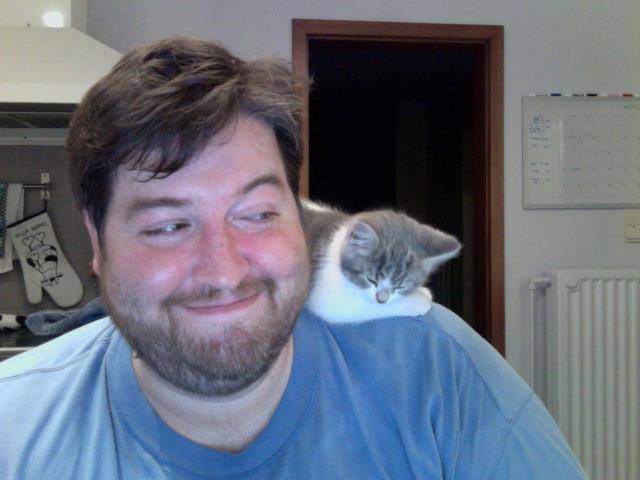
John and Bruges right after he was adopted from the base

John and Bruges right after he was adopted from the base


So recently a few of us resident cat-lovers decided to do something about the problem. We began advocating for the cats, and two of us went so far as to trap three little black kittens living under the math building. Their mom had already moved on, and they were probably about eight or nine weeks old. They were easy to capture using a humane trap, and we took them to our colleague’s little shed beside her house; we call it the Kitty Kabana. For a couple of weeks, these fairly wild little creatures were doing fine: eating and protected from the elements. Unfortunately they were not becoming any less wild. After reading a couple of articles on taming the kittens, we realized they needed to be inside a home, getting used to having people around. Whose home? Ahem. Mine.

Want to find out what happens? Stay tuned…