Life in a Small Town?

In the interest of honesty, I will admit that I started out liking Jason Aldean’s song Life in a Small Town. I liked it because at first glance, I thought that the values of taking care of each other, respecting authority, loving our country, and so on are true. Then I started thinking about “true for whom?”  Again, because I value honesty, I have to admit that I was helped along in thinking about that by a few friends. So, I started reading a little about the backlash. Finally, I asked one of my friends who happens to be a very intelligent young man of color to give me his thoughts once he had processed them. George happens to be a former student who calls me “Mama Sol”; I am lucky to be one of his surrogate mamas. George got back to me the next day. His intellectual honesty was almost shocking.

George said that as a black man from a small town, he recalls hearing that very sentiment, from blacks as well as from whites. And he loves how people do often come together to help one another. Then he reminded me that the song would have had a terrifying meaning 60 years ago or more when lynchings were happening, noting that Jason Aldean’s point of view is rightly that of a white man surrounded by like-minded people. He admitted that it is hard for people to understand the point of view of the “other,” whether the other is the oppressor or the oppressed.

“Black and white culture in the South… has and always will be intertwined. We have been molded by the same landscape, and raised by the same mothers,” he observed.  But he keenly feels the vastly different experiences in that shared culture.

As a white person, I don’t understand fully what black people deal with. As a woman, I do know what it is like to be minimized, marginalized, condescended to, set aside, and abused. And as a human, I have empathy, and I can look at the abuse, torture, injustice, and death, and I feel some of the horror, shock, and outrage my brothers and sisters of color feel. I am appalled that I didn’t see it myself, I, who pride myself (in itself, the first mistake) on seeing the symbolism in music and literature. The song is an anthem for patriotism, love of family, and community. It is also a rallying cry for violence against those who don’t agree with those values.

One of the things I admire about George is he always so practical; he comes back to the basic truth of life. Let’s not stop with the protest for or against the song, but rather let it show us ourselves and our shortcomings. What we need are compassion and empathy. George reminds us that “what wins in the end is compassion, the willingness to understand, and love. Love always wins.”
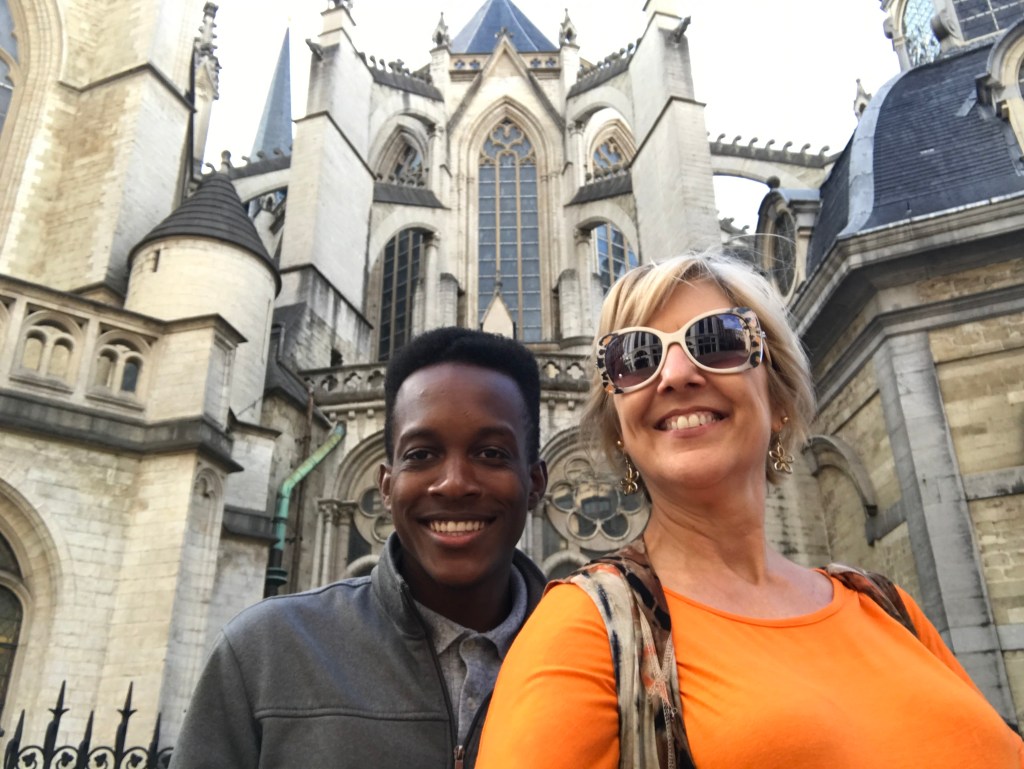
George

I have a self-proclaimed son named George. Born of love, not of blood, he is a friendly, funny, and intelligent fellow, handsome to look at and easy to know, and someone who most consider “an old soul.” He came into my life in his tenth grade Spanish I class, which I was teaching. He discovered in my class that he is “good at” languages (fluent in Spanish by mid-year in level 2), and he got bitten by the travel bug on a trip with me to Spain. He’s now a flight attendant for United and we see each other from time to time, either here in Belgium where I live, or in NC where he’s from, or in an airport somewhere as we cross paths. He really is like a son to me. I love him with whole heart.

George is black. I’m white, if you don’t know. Or sort of peach colored, anyway.

Today another George was killed. By a white police officer while many others looked on. George Floyd was being arrested for a white-collar crime, and by all accounts, and by what video I have seen, he was neither violent nor did he resist arrest. Even if he had resisted, he died making his distress known, pleading for air, the officer’s knee on his neck, until after his body went completely limp, for a total of more than seven minutes.

I can’t help but picture that as MY George. If it had been him in that situation, would he have been treated that way? I suspect he would have. And that scares me.

One thing I do know is if it had been me, a white woman, I would not have been treated that way. And it is a safe bet that my much younger white brother, tall, braw and blond, would have been handcuffed and gently placed into the squad car, his head protected. Even if my brother had resisted arrest, he would have been placed into the car and would likely not have been seriously hurt. He almost certainly would not have been handcuffed and put face down on the ground with an officer’s knee cutting off his airway for so long that he would lose consciousness and die.

What is it going to take for this to stop? Are we to make the black community pay for our sin of slavery and racism for the entire history of the great United States of America? And by the way, who the devil are the people who are raising people so lacking in empathy that they think it is reasonable to hold a calm and unresistant, handcuffed man down by the neck until he loses consciousness? That it is acceptable for a man’s pleas for air and mercy go unheeded? That an unarmed black man can be shot in his car (Philando Castile), in the back execution-style (Oscar Grant), or by vigilantes for jogging (Ahmaud Arbery)? These are only a handful of outrageous events that demonstrate the increasingly dangerous place that the US is for a black man, or even a black woman. Being black (or latino or native American) means your risk of being killed by a police officer is well over twice that if you are white.

Here in Europe, people think we must be the most racist country on the planet. After living here and having friends from lots of countries, I don’t think we are, but it is far more dangerous to be black in the US than it is here, maybe because most people here don’t have guns, and surely because most police officers know when NOT to use deadly force.

I pray for my George. As a law-abiding, taxes-paying black man in America, he is in danger every day. Every time he leaves his house, even when he is IN his house or his car, or at his job, he risks his life. His birth mama taught him to be polite, especially with officers of the law, and I remind him sometimes of how to reach for his wallet to show his identification to an officer who asks for it. I love my brother, too, but I have never reminded him of that; I suspect no one has ever even mentioned it to him. But George knows. He knows he has to ask the officer if he can get his identification out. He knows to move slowly and keep one hand in the view of the officer at all times. He knows the officer is likely to kill him.

I know, too.