Waiting

I’m sitting about 100 meters from a humane trap in which I’m hoping to catch what I’ve been told is a pregnant cat. I’m listening for that distinctive clap which tells me that the trap has sprung and the desired prey is safely inside. This is the fourth time I have set the trap for this particular cat. She’s quite wild, and she’s very clever. Perhaps she’s been listening to her pal tell her about when I trapped her and had her spayed a couple of weeks ago, a successful, although stressful TNR.

(TNR means Trap-Neuter-Release, the only option to successfully control a community cat population.)

Within the confines of the NATO base where I teach are a number of cats who don’t have family to go home to. Over the course of the last six years, on the campus of the school on base, and on the American base a few miles from here, some friends and I have trapped or otherwise assumed responsibility for upwards of 50 cats and kittens. The ones on the NATO base are primarily the cats abandoned by military members when they PCS, or are the offspring of those cats. Many of them, like the last five, have been kittens, which I and my compassionate cohorts have socialized and either found homes for or found no kill associations which found homes for them.

The adult cats have been much more difficult. Often they have become very distrustful of humans, and a few have been downright feral. The solution for those is very complicated. Some of them have been released in areas unfamiliar to them. I deeply resist that option because sometimes it turns out very badly. One such cat was kept in the ladies garage for several weeks, where the lady fed her, spoke softly to her, and even petted her some. In spite of this, when the cat was finally released, she ran off and was never seen again, breaking the hearts of her caregivers; I still worry about this cat sometimes. Obviously we don’t want that outcome. Ideally a cat who is truly wild, or who is so fearful of humans that they can’t let themselves be socialized, needs to be released where he was trapped. Luckily in this case there is a lady who has been feeding this small colony of cats and because of her, I was alerted and we are now trying to get this population of community cats TNR’d.

In spite of my repeated requests on social media for people to let me know when they’re getting ready to leave so that I can come by and get their cat or find a suitable home for it, folks continue to abandon their animals when they leave. Dogs get dumped at shelters, and cats simply get left behind. I always thought it was “those other countries ” who were doing such things, but I’ve come to learn that we Americans are just as guilty as everybody else.

Even after all these years associated with animal rescue, I still can’t understand how you can do that. How can you welcome an animal into your home without coming to love it? And how can you love anyone or anything and decide that they’re not worth taking with you when you go? Did you know that there are even people who abandon their animals when they go on vacation? They simply turn it out if it’s a cat, or if it’s a dog they tie it to a lamp post by the side of the road.

Before I became an animal rescuer I didn’t realize such things happened. I wouldn’t say that I was living in a state of complete ignorance; in fact I had spent many years weeping over articles that I read, statistics, and photographs. I belonged to the ASPCA, the Humane Society of the United States, and subscribed to vegetarian magazines. For a time I was a member of PETA until I realized that they too are simply an animal killing machine. But until I became an actual rescuer myself, I didn’t realize that our next-door neighbors and sometimes even our friends are not really animal lovers or even animal likers. Because if they were, these “good people” wouldn’t abandon their animals leaving, in the best possible situation, other people to pick up pieces.

So I’m sitting here waiting for that trap, praying that tonight will be the night that this female cat goes into it. Cross your fingers. Say a prayer.
Ferals and Fosters, Part Two

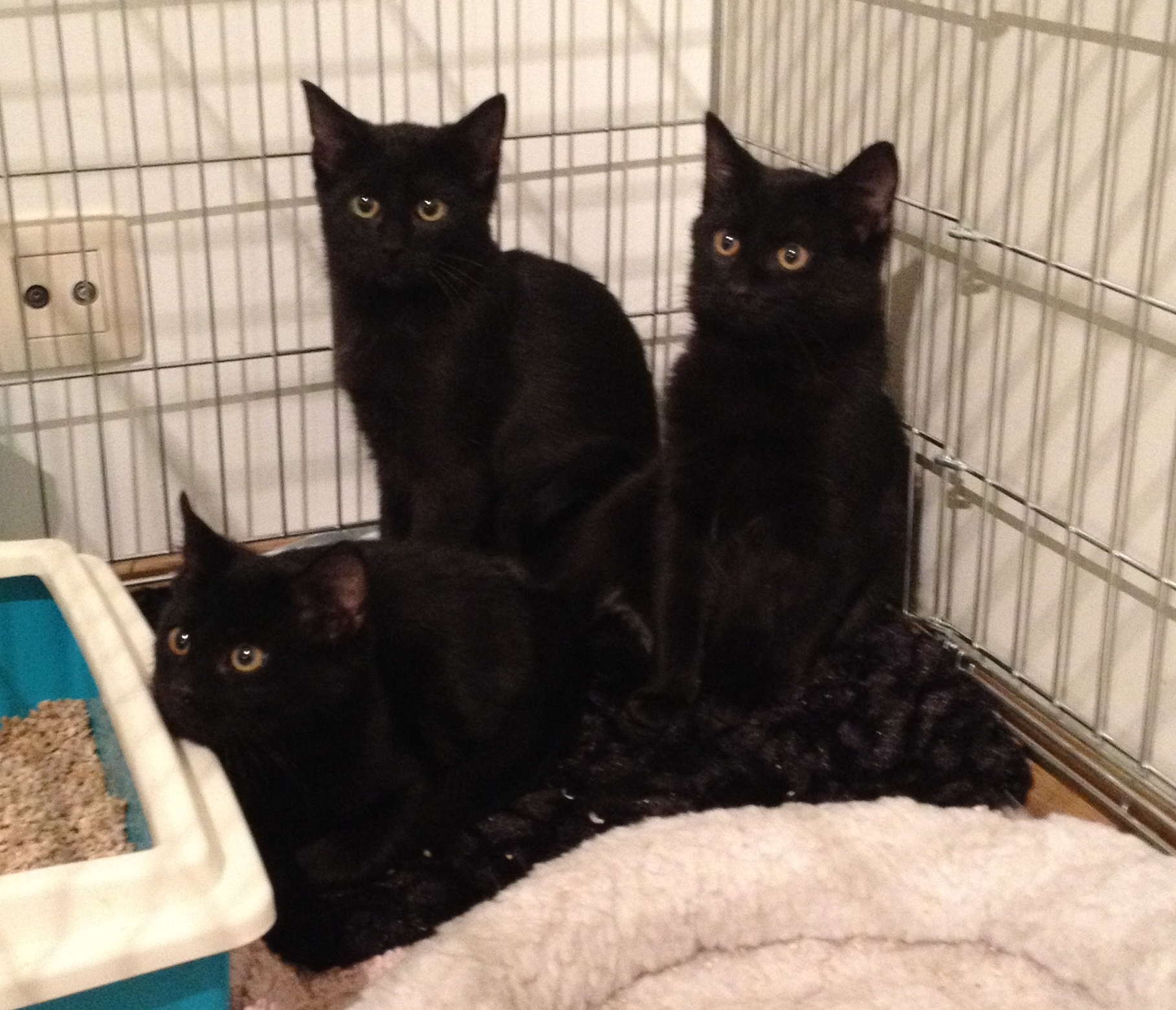
Yesterday, I posted about our base’s feral cat problem, and the three cats a couple of friends and I decided to rescue. Kittens, actually, about three months old. Feral kittens, to be precise. And they were coming home with me. Why me? Because I was the sucker of the three of us that was willing to spend the time trying to socialize them.

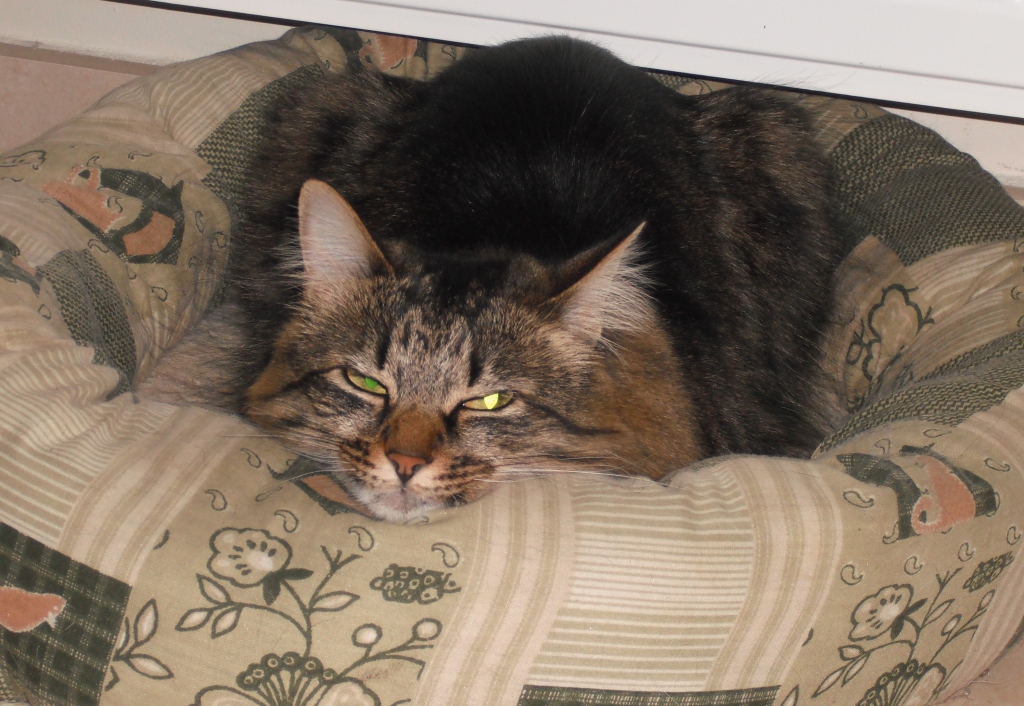
Now you should know, gentle reader, that I’m a terrible foster mom for cats. One of my cats, Maggie, is a failed foster. She came to me after having been found in a car engine as a tiny kitten. I tried to find a home for her but finally resigned myself to the fact that she would be mine. And she is; she loves me as much as any animal I’ve ever had, I think. I can’t imagine giving her up.

Maggie, my failed foster

Maggie, my failed foster

There were only two possible ends to this, neither of them good. One, with me as the crazy cat lady with six cats and no boyfriend (ever) or two, with me in tears watching my darling little furbabies ride away with their new family. Nevertheless, I brought the three little lovelies home.  I set up a borrowed extra-large kennel in a guest bedroom. I covered everything up, even putting a large shower curtain on the bed, under the fitted sheet, to prevent permanent damage from potential accidents. I blocked off ways to get under the bed because it is vital that kittens who need to be socialized not be able to hide from the human. My plan was to let the kitties out when they felt more comfortable, and to come in and sit with them often, letting them get used to me, begin to trust me, and eventually, hopefully become domesticated enough to be adopted.

The first night I left them free in the guest room while I slept down the hall, and all was well. They scampered into the kennel in the morning and I latched the door and went to work. That evening, I went and sat with them for an hour or so, working on my computer and talking to them softly. The following morning, there was a pile of cat poo in the middle of the bed. Well, no real damage done, I thought, and off I went to do laundry before work.

Three little fosters...

Three little fosters…

The next morning, same thing. And the next, the poo was surrounded by a veritable small pond of pee. And on top of that, they had managed to get under the bed. Well, then. An hour or so later, there was more laundry in the washer, the kittens were back in the kennel, and under the bed was once again blocked off.

The next morning, exactly the same scenario. Seriously? I mean, SERIOUSLY?

To say I was frustrated would be a vast understatement. I was seriously considering taking them back to the Kitty Kabana…

To be continued…

Ferals and Fosters, Part One

A few weeks ago, the military base where I work began talking about “getting rid of” the base’s feral cats. This particular military base is home to families from a lot of different countries, all either NATO or partner nations. Relatively few of the families are American; our presence is so numerous that we have to live off base. Which is fine with me; I love living out among the Belgians! But I digress.

Pet ownership is as popular in Europe as it is in the US, but the attitude regarding spaying and neutering is vastly different. While becoming more accepted, elective spay-neuter remains the exception. The prevalent paradigm in some countries is even that such surgery is cruel. This means, of course, that when families on the base where I work get a cat or a dog, there is a high likelihood that the animal will reproduce at some point in the near future. Add that to the fact that sometimes a family will PCS (Permanent Change of (duty) Station, i.e. “move”) and simply abandon their cat, and you have a recipe for exactly what has happened here on the base, and particularly near our ancient school buildings: cats give birth to kittens, kittens don’t have human contact, and POOF! Feral cats.

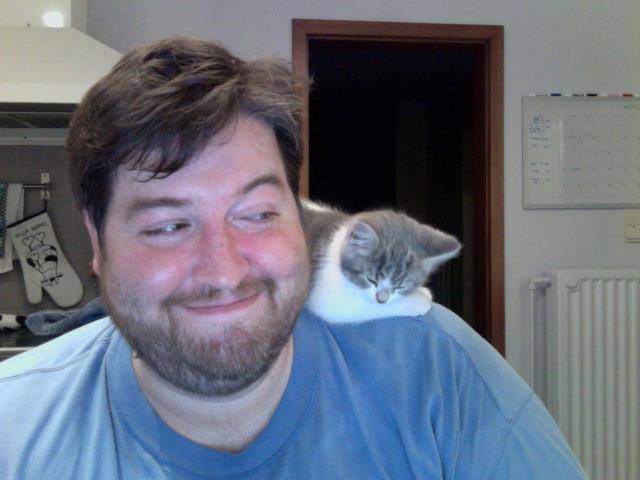
Our base’s history of feral cats is long and colorful. There is even a story of one falling through the drop ceilings and into a classroom! You can stop laughing now. Or go ahead and laugh; it is pretty funny, I admit. And several friends have adopted kittens that were born homeless to feral parents. When such kittens are adopted as soon as possible after they are born, they quickly socialize to humans. Such is exactly the case with my friend John and his best pal, Bruges.

John and Bruges right after he was adopted from the base

John and Bruges right after he was adopted from the base


So recently a few of us resident cat-lovers decided to do something about the problem. We began advocating for the cats, and two of us went so far as to trap three little black kittens living under the math building. Their mom had already moved on, and they were probably about eight or nine weeks old. They were easy to capture using a humane trap, and we took them to our colleague’s little shed beside her house; we call it the Kitty Kabana. For a couple of weeks, these fairly wild little creatures were doing fine: eating and protected from the elements. Unfortunately they were not becoming any less wild. After reading a couple of articles on taming the kittens, we realized they needed to be inside a home, getting used to having people around. Whose home? Ahem. Mine.

Want to find out what happens? Stay tuned…