A few weeks ago, the military base where I work began talking about “getting rid of” the base’s feral cats. This particular military base is home to families from a lot of different countries, all either NATO or partner nations. Relatively few of the families are American; our presence is so numerous that we have to live off base. Which is fine with me; I love living out among the Belgians! But I digress.
Pet ownership is as popular in Europe as it is in the US, but the attitude regarding spaying and neutering is vastly different. While becoming more accepted, elective spay-neuter remains the exception. The prevalent paradigm in some countries is even that such surgery is cruel. This means, of course, that when families on the base where I work get a cat or a dog, there is a high likelihood that the animal will reproduce at some point in the near future. Add that to the fact that sometimes a family will PCS (Permanent Change of (duty) Station, i.e. “move”) and simply abandon their cat, and you have a recipe for exactly what has happened here on the base, and particularly near our ancient school buildings: cats give birth to kittens, kittens don’t have human contact, and POOF! Feral cats.
Our base’s history of feral cats is long and colorful. There is even a story of one falling through the drop ceilings and into a classroom! You can stop laughing now. Or go ahead and laugh; it is pretty funny, I admit. And several friends have adopted kittens that were born homeless to feral parents. When such kittens are adopted as soon as possible after they are born, they quickly socialize to humans. Such is exactly the case with my friend John and his best pal, Bruges.
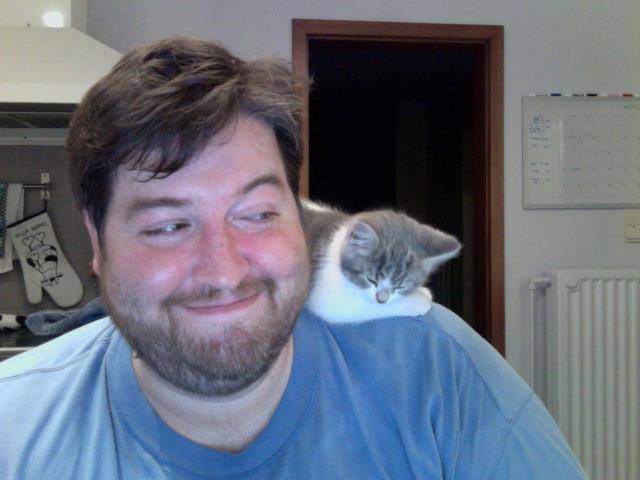
John and Bruges right after he was adopted from the base
So recently a few of us resident cat-lovers decided to do something about the problem. We began advocating for the cats, and two of us went so far as to trap three little black kittens living under the math building. Their mom had already moved on, and they were probably about eight or nine weeks old. They were easy to capture using a humane trap, and we took them to our colleague’s little shed beside her house; we call it the Kitty Kabana. For a couple of weeks, these fairly wild little creatures were doing fine: eating and protected from the elements. Unfortunately they were not becoming any less wild. After reading a couple of articles on taming the kittens, we realized they needed to be inside a home, getting used to having people around. Whose home? Ahem. Mine.
Want to find out what happens? Stay tuned…
 What Living Feels Like